
By Desire Tshuma
MUREHWA – China has pledged to remain firmly at Zimbabwe’s side as the country continues to rebuild communities battered by the devastating effects of the El Niño-induced drought, with a new partnership expected to bring critical relief to more than 200,000 vulnerable people.
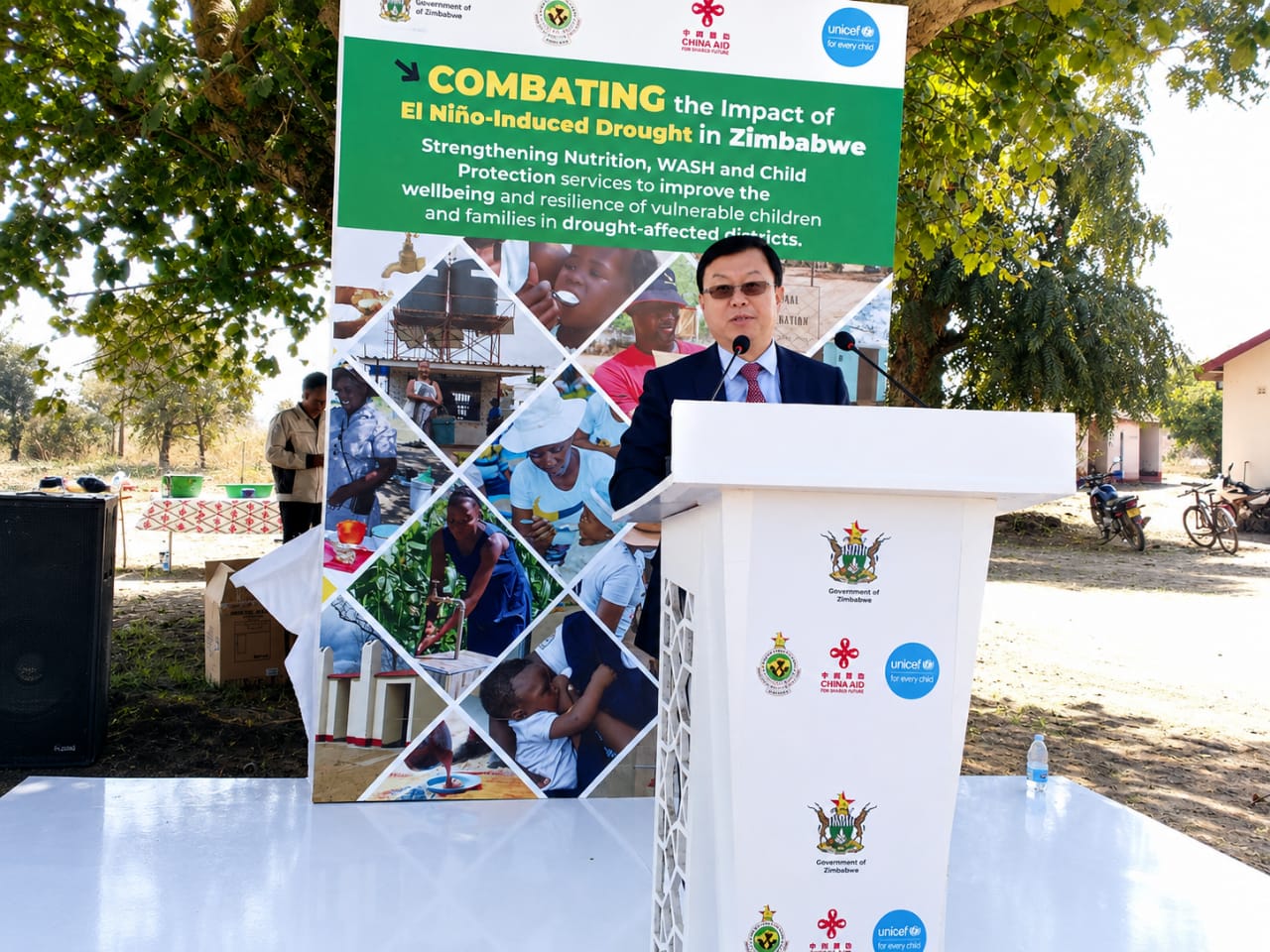
The commitment was made on Friday, 7 August 2026, during the launch of the China Aid Grant Project at Kowoyo Clinic in Goromonzi East, Goromonzi District, Mashonaland East Province, being implemented in partnership with UNICEF Zimbabwe.
The programme seeks to combat the impact of drought through improved nutrition, water, sanitation and hygiene (WASH), and child protection, targeting eight drought-stricken districts.
The launch brought together senior Government officials, the Chinese Embassy, UNICEF, local authorities and community representatives.
Among the dignitaries were Chinese Ambassador to Zimbabwe Zhou Ding, Deputy Minister of Health and Child Care Sleiman Timios Kwidini, Deputy Minister of Sport, Recreation, Arts and Culture Hon. Emily Jesaya, and Mashonaland East Minister of State for Provincial Affairs and Devolution Advocate Itai Ndudzo.
Also present was Mrs Etona Ekole, UNICEF Representative in Zimbabwe, alongside other senior Government officials, local leaders, community representatives and invited guests.
Ambassador Zhou said China remained committed to translating the friendship between the two countries into practical assistance for ordinary Zimbabweans.
“Looking ahead, China will continue to stand firmly alongside Zimbabwe as the country presses ahead with its NDS2 agenda and pursues industrialisation and modernisation,” Ambassador Zhou said.
“I am ready to work hand in hand with our Zimbabwean friends and partners to translate our shared vision into more tangible results on the ground, and to jointly build an all-weather China-Zimbabwe community with a shared future.”
Zimbabwe suffered one of its most severe droughts in decades in 2024, with the El Niño weather phenomenon causing acute water shortages, crop failures and pressure on sanitation services.
Millions of vulnerable people were left facing hunger and limited access to safe water, prompting Government and development partners to intensify humanitarian and resilience-building interventions.
Ambassador Zhou said China responded by mobilising emergency assistance, including three batches of food aid comprising 10,000 metric tonnes of wheat and rice.
China also rolled out its 300 Boreholes Project, which has supplied clean drinking water to more than 75,000 people across 300 villages in four provinces.
The new China-UNICEF programme represents a shift from emergency relief towards longer-term community resilience.
“The project we officially launch today stands as another powerful testament to the fraternal bond between China and Zimbabwe,” Ambassador Zhou said.
“Through our partnership with UNICEF Zimbabwe, we aim to further support Zimbabwe’s national efforts to mitigate drought shocks and advance the well-being of vulnerable populations.”
Once fully implemented, the programme is expected to provide direct support to more than 200,000 people across eight drought-stricken districts, with interventions designed to address the interconnected challenges of malnutrition, lack of clean water, poor sanitation and the protection of children.
Ambassador Zhou said the assistance should not be viewed as a once-off humanitarian intervention.
“Our work here goes far beyond one-off humanitarian relief. Through these carefully devised projects, we seek to reinforce community resilience and enhance Zimbabwe’s national self-reliance and sustainable development capacity,” he said.
He said China was also looking forward to strengthening cooperation with UNICEF and other United Nations agencies to improve the welfare of Zimbabweans.
“I also look forward to deepening our co-operation with UNICEF and other UN agencies to create a brighter, more prosperous tomorrow for the Zimbabwean people,” Ambassador Zhou said.
The Chinese envoy also highlighted the contribution of Chinese businesses to communities through corporate social responsibility initiatives.
He cited Prospect Lithium Zimbabwe in Goromonzi as one example, saying the company had contributed more than US$5 million to corporate social responsibility programmes covering education, medical care, poverty relief and livelihood improvement since commencing operations in 2022.
Beyond humanitarian assistance, Ambassador Zhou said China was committed to supporting Zimbabwe’s broader economic development and industrialisation agenda.
He said China’s introduction of zero-tariff treatment for Zimbabwean exports to China from 1 May 2026 was expected to improve the competitiveness of Zimbabwean products and create opportunities for grassroots communities.
The launch marked another step in the growing China-Zimbabwe partnership, with the two countries seeking to turn humanitarian support into sustainable improvements in the lives of communities most affected by climate shocks.