
By Bigboy Madzivanzira
I found a video on the CAN Africa Network Country Representatives Group that has not left my heart.
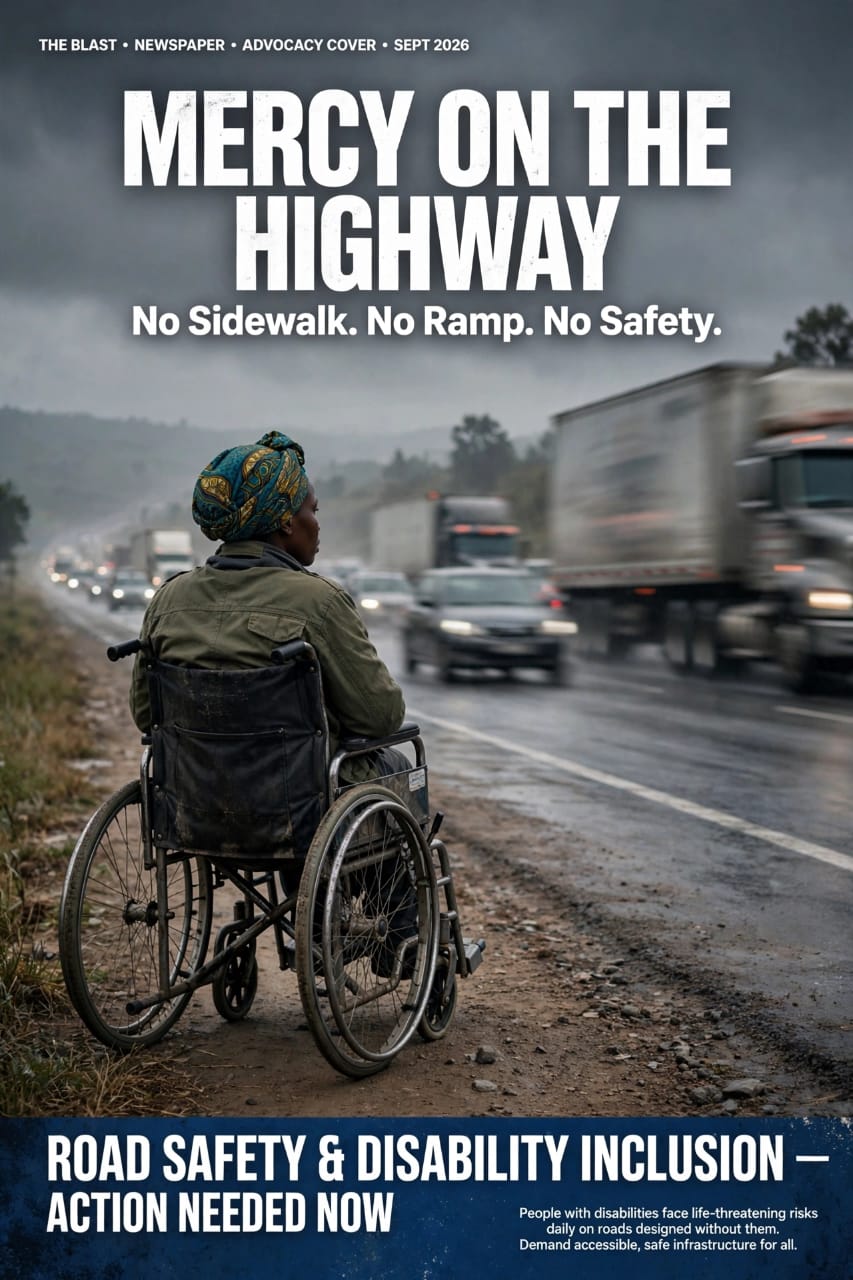
Her name is Mercy. She is not a patient. She is a daily commuter. Just like you and me.
But Mercy commutes in a manual wheelchair, in the middle of a busy highway, squeezed between a 30-tonne container truck and speeding cars. The video is filmed from a bicycle behind her. You can hear the fear in the cyclist’s text:
“Meet Mercy… a daily commuter just like me. Saw her today and was so worried. Do the drivers even see her?”
We talk about inclusivity, but here we are.
This sentence sums up Africa’s failure.
There is no cycling lane for the cyclist. There is no sidewalk for Mercy. The caption says: “The sidewalk would have been much safer but it doesn’t even exist!”
When Mercy wants to use public transport, a matatu, a kombi, a ZUPCO — there is no ramp. “They don’t have access to ramps!”
Rainy season is here. What happens to manual wheeling in mud?
The most climate-friendly commuters are punished.
This is what struck me as a climate justice advocate. Mercy and the cyclist are using zero-emission transport. Wheelchair and bicycle. They are living the Just Transition we talk about in conferences.
But our cities give the entire road to fuel trucks and cars. We build highways without sidewalks, without wheelchair lanes, without ramps on buses. Then we call ourselves inclusive.
The video says: “I’m sure the Persons with Disabilities Act guarantees a barrier-free environment. But our leaders don’t give that a priority. Implementation lags behind legislation. And people like Mercy are left to engineer their own dangerous workarounds to earn a living.”
This is exactly what is happening in Zimbabwe.
Our Persons with Disabilities Act [Chapter 28:02] guarantees accessibility. Our National Disability Policy promises barrier-free environments. But go to Harare-Bulawayo Road, Seke Road, Masvingo Road — you will see our own Mercys forced into traffic because the side path is a ditch.
One blind spot from a truck driver and we have another spinal cord injury, another family destroyed, another person I will have to rehabilitate at our centre.
What we need is not charity. It is a safe road.
As a Rehabilitation Practitioner, we call for:
1. City of Harare, Bulawayo, Masvingo: Every new road must have a paved sidewalk and a dedicated non-motorized lane for bicycles and wheelchairs.
2. Ministry of Transport: All public buses, including ZUPCO, must have ramps and wheelchair securement. Inclusivity is not a luxury.
3. Implementation, not more laws: We have good laws. Enforce them. Audit roads for accessibility.
Mercy’s story is sad. The video ends with: “Sad state of affairs… but hoping things will get better.”
Things will only get better if we, the practitioners, the climate activists, the town planners, refuse to look away.
Mercy is not asking for a favour. She is asking for a safe way to go to work.
Is that too much to ask?
About the Author
Bigboy Madzivanzira is a Medical Rehabilitation Practitioner based in Harare, Zimbabwe. He is the Founder and Director of Health Promotion Clinic Trust. The Chairperson of Disabled Women Support Organization, the Board Secretary of Isheanesu Multipurpose Centre for children with disabilities and CAN Africa Network Zimbabwe Country Representative and a passionate advocate for disability inclusion, He writes on public health, rehabilitation, and social justice. Bigboy can be contacted on 0773 367 913 or healthpromotionclinic@gmail.com