
By Desire Tshuma
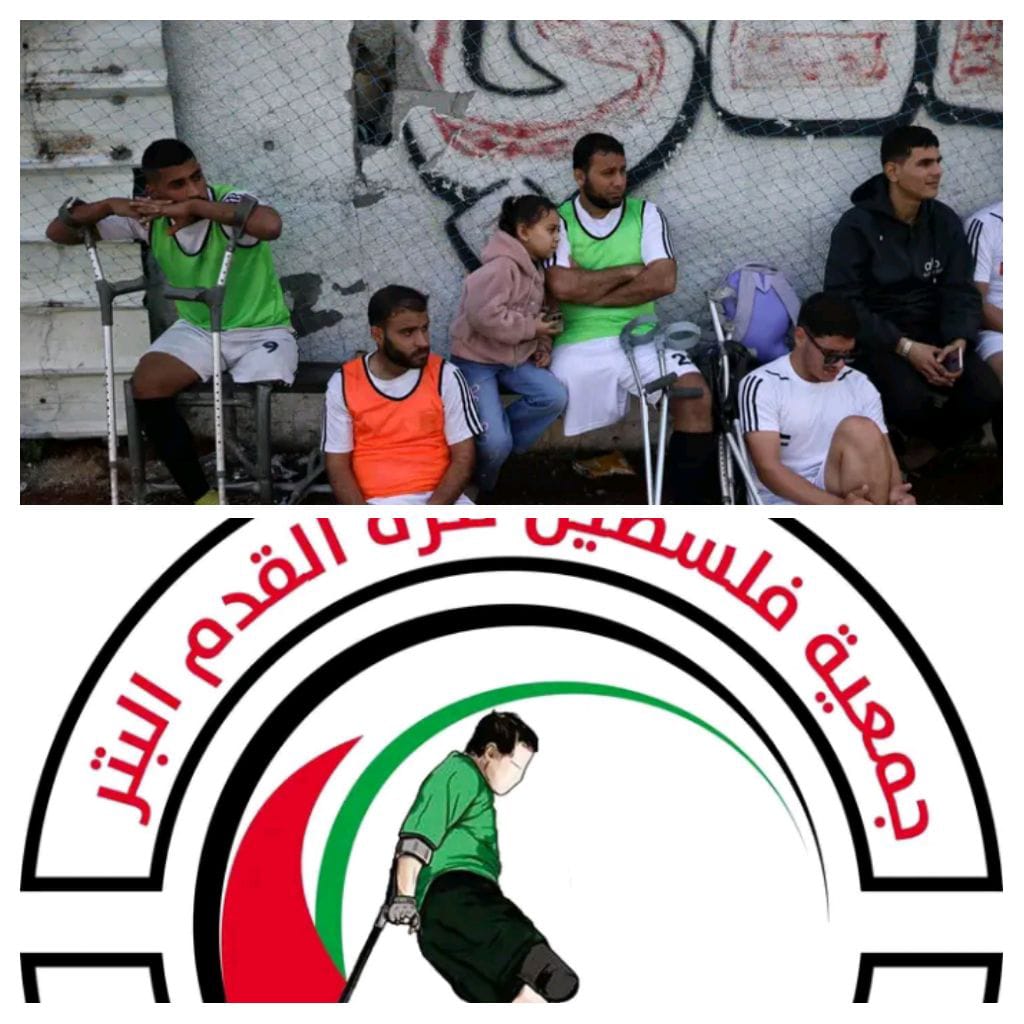
GAZA — Palestinian amputee footballers from Gaza have honoured former Manchester City manager Pep Guardiola as their honorary coach, holding aloft his image in a tribute that has become a symbol of remembrance for a war that has left thousands of survivors with life-altering injuries.
The Gaza amputee football team, known as Al-Irada, said the honour was in recognition of Guardiola’s public expressions of solidarity with Palestinians and his concern for children caught in conflict. The Spanish coach has previously spoken emotionally about children affected by war, including Palestinian children. In February 2026, he signed Palestine national-team shirts for the amputee side.
For players who have lost legs and arms, the gesture carries meaning far beyond football. Their pitch is a reminder of what war leaves behind after headlines fade — artificial limbs, wheelchairs, scars, missing relatives and shattered homes.
Behind every prosthetic limb is a story, and the numbers behind those stories are staggering.
Since the Hamas-led attack on Israel on October 7, 2023 and Israel’s subsequent military campaign in Gaza, the Palestinian death toll has climbed beyond 73,000, according to figures reported by Gaza health authorities and cited by Reuters in September 2026.
UNICEF says that by June 30, 2026, at least 21,700 children had been reported killed in Gaza since October 2023, while about 45,000 children had been injured, including more than 11,000 suffering life-altering injuries. Even after the October 2025 ceasefire, children continued to die. UNICEF reported that at least 300 children were killed during the 300 days following the ceasefire announcement, an average of about one child every day.
The United Nations has documented the continuing danger faced by civilians. In September 2026, OCHA reported that 21 people, including 12 children, were killed when a war-damaged residential building collapsed in Gaza City. More than 630 bodies and human remains had been recovered from destroyed buildings between November 2025 and September 2026, while more than 8,000 people were estimated to remain missing beneath the rubble.
The destruction has also reached the people whose job was to save lives. Data compiled by Insecurity Insight showed that, by June 23, 2026, 770 health workers had been killed in Gaza since October 7, 2023, alongside thousands of reported attacks affecting health care.
The World Health Organization has described Gaza’s health system as severely degraded, with hospitals operating far beyond capacity and thousands of people requiring long-term rehabilitation. WHO reported in March 2026 that cumulative amputations in Gaza had exceeded 5,000 cases since October 2023.
That figure gives the image of the amputee footballers another dimension. They are not merely footballers. They are survivors carrying, on their bodies, a record of the war.
The war has also exacted an extraordinary price from those attempting to document it. The Committee to Protect Journalists said in June 2026 that it had documented 209 journalists and media workers killed by Israel in Gaza and Israeli detention centres since October 7, 2023, following a review that removed individuals subsequently established to have been combatants or otherwise outside its journalistic criteria. CPJ has repeatedly stressed that documenting deaths in Gaza is exceptionally difficult because international journalists have been denied normal access to the territory, communications infrastructure has been destroyed and evidence has been lost.
The United Nations has separately recorded an extraordinary loss among its own personnel. In June 2026, Secretary-General Antonio Guterres said 80 UNRWA personnel were among 136 UN personnel being commemorated for deaths in the line of duty during the previous year. He said more UN colleagues had been killed in Gaza than in any other conflict or disaster in the UN’s history.
And then came another image, this time not from a football field, but from the world’s diplomatic stage. When Benjamin Netanyahu addressed the United Nations General Assembly in September 2025, numerous delegations walked out as the Israeli prime minister approached the podium, leaving large sections of the chamber empty. The episode was widely reported as a protest against Israel’s conduct of the Gaza war. As Netanyahu prepared to address the UN again in September 2026, Israel’s own UN ambassador Danny Danon acknowledged that another protest was expected, recalling the previous year’s mass walkout.
The empty seats became a picture in their own right. For Palestinians, they could be read as a symbol of diplomatic protest. But an empty chair also raises a harder question of what happens after the cameras leave.
That is why the Palestinian amputee footballers’ tribute to Guardiola resonates beyond football. He did not stop the war. He did not negotiate a ceasefire. He could not bring back the dead. But his words reached people who had become accustomed to watching the world debate their suffering from a distance.
For the players, the honour appears to be about recognition, the recognition that someone with a global platform saw them not merely as numbers in a casualty report, but as human beings.
Football is supposed to be about two teams, one ball and 90 minutes. In Gaza, however, football has become something else, a declaration that losing a limb does not mean losing dignity, that surviving does not mean becoming invisible, and that children who have grown up among ruins can still dream of a pitch.
The players’ tribute to Guardiola therefore tells a larger story about memory, about what remains after the missiles stop, about the journalists who kept reporting until they could no longer report, about doctors who kept treating patients while hospitals collapsed around them, about children whose lives ended before adulthood, and about amputee footballers who, having already lost pieces of their bodies to war, still found a reason to put on a jersey and play.
The world may remember Gaza through numbers. They remember it through faces. And Guardiola’s picture, held aloft by men who survived the unimaginable, has become one of those faces of remembrance.