
By Persistence Gwanyanya
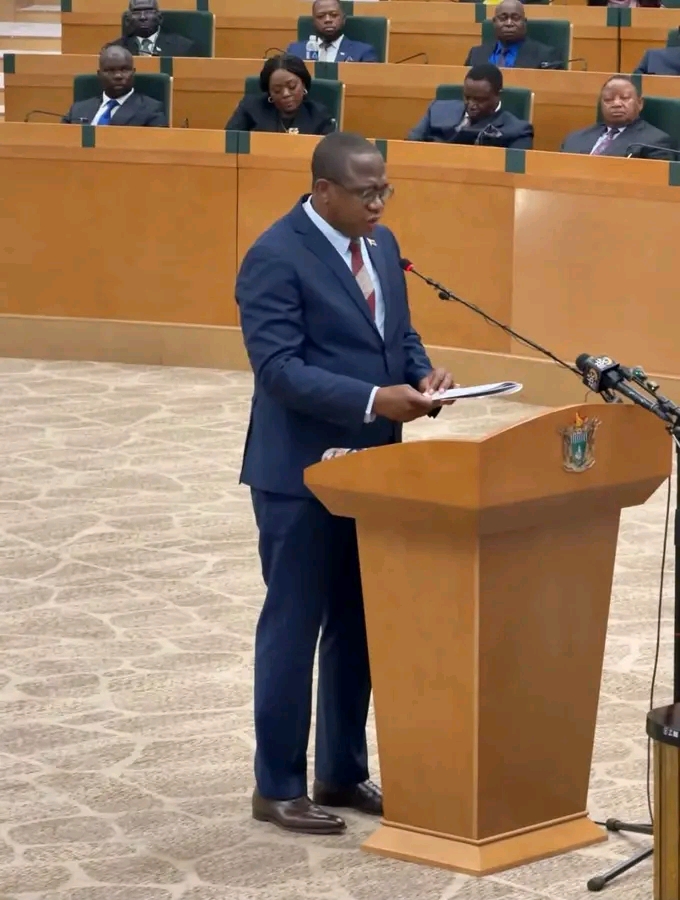
Finance Minister Professor Mthuli Ncube presented the 2027 National Budget Statement amid cautious optimism over Zimbabwe’s economic progress, while warning of potential external threats, including an El Niño-induced drought and conflict in the Middle East.
To mitigate the anticipated drought, Government has introduced a six-pillar response strategy focusing on Strategic Grain Reserves, climate-smart agriculture, financing, livestock protection, grain imports, capacity building and early warning systems.
Government has also expanded irrigation infrastructure, increasing the area under irrigation from approximately 175,000 hectares in 2018 to 308,000 hectares currently.
Treasury has procured 365,000 tonnes of grain and is targeting a 600,000-tonne Strategic Grain Reserve by August 2027. The Pfumvudza/Intwasa programme will also continue receiving support.
Reindustrialisation Key to Economic Growth
Gwanyanya said the success of the 2027 Budget would largely depend on economic restructuring, particularly strengthening the manufacturing sector.
Although manufacturing is emerging as a key growth driver, its contribution remains at 17 percent of GDP, below the National Development Strategy (NDS) target of 25 percent.
He said deep industrialisation was essential for improving global competitiveness, creating formal jobs and reducing Zimbabwe’s 76.1 percent informality rate.
A stronger manufacturing base would also help address balance of payments and budget deficits by reducing import dependence and promoting local value addition and exports.
The Budget introduces measures to support industrialisation, including reducing the Intermediated Money Transfer Tax (IMTT), suspending duties on semi-knocked-down (SKD) kits and providing duty rebates on selected raw materials, intermediate inputs and capital equipment used in fertiliser manufacturing.
Strengthening Demand for the ZiG
Gwanyanya said Government should continue strengthening domestic demand for the Zimbabwe Gold (ZiG) currency.
He noted that ZiG inflation was averaging four percent, while gross reserves had reached approximately US$2 billion.
Government has already mandated that 50 percent of corporate taxes be paid in local currency.
He recommended expanding tax obligations payable in ZiG and increasing public sector payments in the currency to strengthen its usage and confidence.
The Budget also increases capital expenditure to 3.8 percent of GDP in 2027, up from 2.3 percent in 2026.
Capital spending is projected at US$2.6 billion, representing 20.5 percent of the total Budget.
Debt Clearance and Infrastructure Development
Gwanyanya said resolving Zimbabwe’s US$22.2 billion national debt remained critical to unlocking financing for economic development.
The country owes approximately US$3 billion in arrears to international financial institutions, including the World Bank, African Development Bank and European Investment Bank.
He said successful implementation of the International Monetary Fund Staff-Monitored Programme (SMP) had improved prospects of securing bridging finance in 2027 to clear arrears and restore the country’s borrowing status.
He also highlighted the Infrastructure Development Fund (IDF), which has arranged a US$400 million facility to support national infrastructure projects.
Key projects include the Beitbridge-Harare, Harare-Chirundu and Bulawayo-Victoria Falls highways.
The Budget also promotes green investment through a reduction in customs duty on electric vehicles and related infrastructure from 25 percent to 10 percent.
Broadening the Revenue Base and Social Protection
Gwanyanya said Zimbabwe needed to broaden its revenue base, noting that 95 percent of the Budget was funded through direct taxation, placing significant pressure on the formal sector.
He welcomed measures to widen the tax base, including scrapping the 25 percent duty on mobile phones to encourage financial inclusion and economic formalisation.
Treasury allocated ZiG21.5 billion (US$827 million) to the Ministry of Public Service and Social Welfare, which oversees social protection programmes.
He also welcomed the commitment to clear outstanding Basic Education Assistance Module (BEAM) arrears and the increase in the tax-free threshold from US$100 to US$150.
However, he urged Government to continue reviewing civil servants’ salaries to ease the cost-of-living burden.
Macroeconomic Stability
Gwanyanya said fiscal and monetary policy coordination remained important in maintaining price and currency stability.
He welcomed proposed amendments to the Reserve Bank Act to reduce the statutory Government borrowing limit from the central bank from 20 percent to five percent of the previous year’s revenue.
He noted that Government had not borrowed from the central bank under the existing limit, demonstrating fiscal discipline.
He said the growth in foreign currency reserves, together with single-digit inflation and currency stability, provided a positive foundation for 2027.
Gwanyanya said the 2027 National Budget provided a framework for navigating external economic shocks, but its success would depend on accelerating industrialisation, strengthening demand for the local currency and implementing debt clearance strategies.
Persistence Gwanyanya is an economist, chartered banker, member of the RBZ Monetary Policy Committee and founder and CEO of Bullion Group International.