
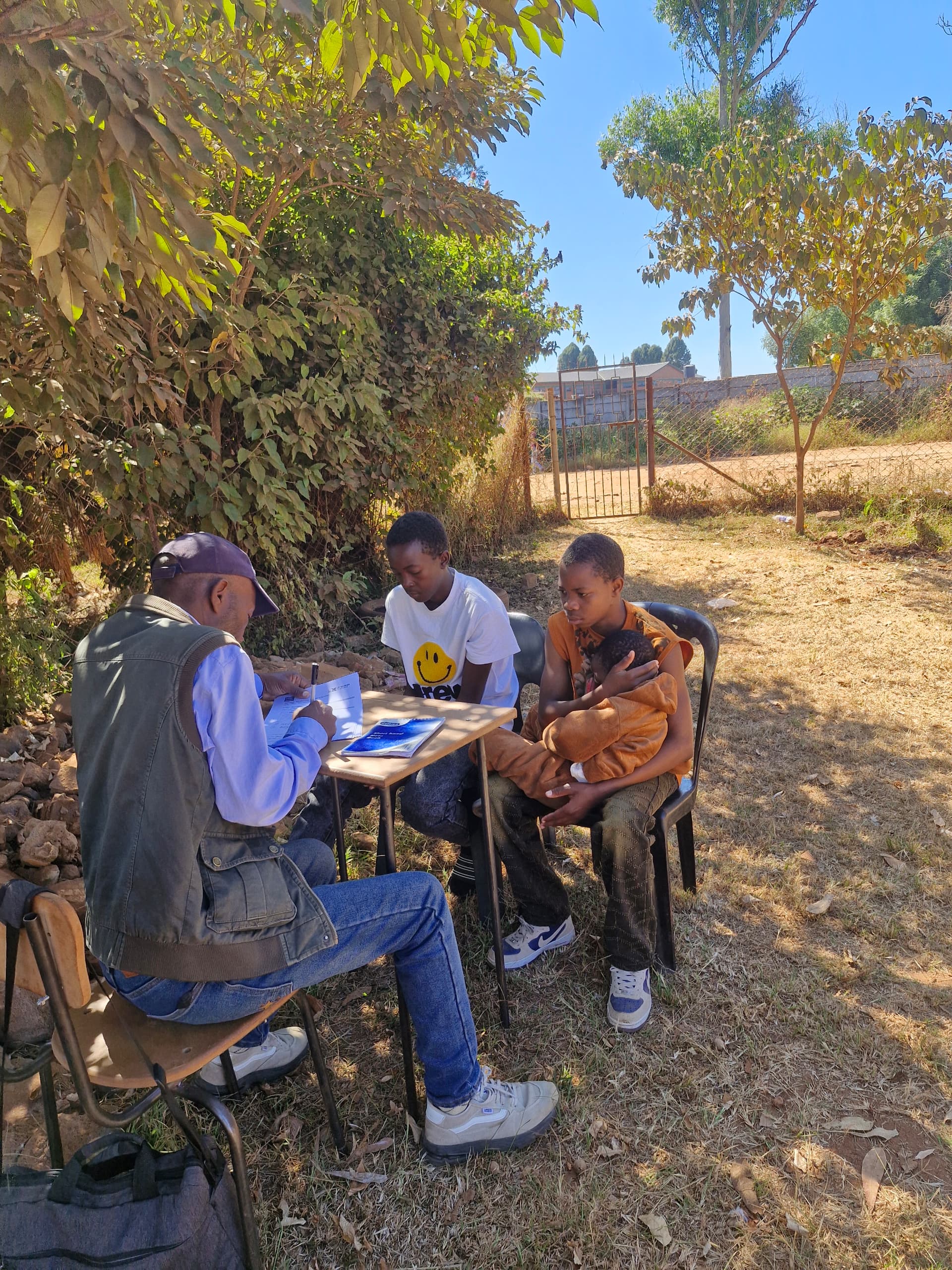
HARARE– St Christopher’s Children with Disability, in partnership with Health Promotion Clinic Trust, HPCT Zimbabwe and government ministries, has launched a four-day community-based rehabilitation outreach that is bringing assessment and rehabilitation planning directly to children with disabilities in their own communities.
The outreach, which began on 6 May 2026, reflects the Government’s strong commitment to supporting persons with disabilities through a coordinated, multi-ministry approach . The Ministry of Primary & Secondary Education and the Department of Social Services are working alongside St Christopher’s Children with Disability and Health Promotion Clinic Trust to ensure that no child is left behind.
COVERAGE AND VENUE
Assessments are being conducted at St Joseph Anglican Church in Hatcliffe, with children attending from Hatcliffe, Domboshava and the surrounding farming communities.
A total of 24 children have been assessed out of 38 expected so far. The lower turnout was partly attributed to mobility challenges, with some older children difficult to transport to the assessment point.
CATCHING UP TODAY
The team is aiming to assess 38 children daily over the four-day outreach. To cover those who did not attend earlier, additional assessments will be conducted today alongside the scheduled cases.
FIVE SECTORS, ONE CHILD, ONE PLAN
The outreach uses a five-station assessment model covering physical and mental health, education access, social protection, caregiver empowerment, and coordination.
Health Promotion Clinic Trust, HPCT Zimbabwe is leading the functional health screening, assessing mobility, communication and daily living skills using a standardised Needs and IRP Tool.
“The Needs and IRP Tool was designed to ensure that every child is assessed holistically across all five focal areas of Community-Based Rehabilitation,” said Tawanda Nhamburo of JF Kapneck, the donor supporting the programme. “It gives us a complete picture of the child’s needs so that the rehabilitation plan is practical and sustainable at household level.”
EDUCATION ACCESS IN CBR SETTINGS
The Ministry of Education is evaluating school readiness and learning barriers for each child. In line with some children with disabilities not attending school, Marrian Mazingi of the Ministry of Primary and Secondary Education said, “Home schooling is ideal in our CBR setting because it allows us to meet the child where they are and tailor learning to their abilities while still linking them to the formal education system where possible.”
SOCIAL PROTECTION AND HOUSEHOLD SUPPORT
The Department of Social Services is reviewing household safety, birth registration status and eligibility for food grants during the assessments. “Many families of children with disabilities face multiple layers of vulnerability, from lack of documentation to food insecurity,” said Rejoice Ziki, Social Services Officer. “By bringing social protection assessments into the community, we can identify eligible households on the spot and link them to existing government support programmes without delay.”
St Christopher’s Children with Disability is coordinating community mobilisation and follow-up.
IRPs FROM A FULL NEEDS ASSESSMENT
The Individual Rehabilitation Plans, IRPs, developed for each child are the direct result of this combined multi-ministry needs assessment. This integrated approach ensures that the plan addresses the child’s physical, educational, social and empowerment needs in a coordinated manner, with input from all partners involved.
Plans are designed for implementation at home using available resources, to ensure continuity between monthly Community Rehabilitation Worker, CRW, visits.
URGENT NEED FOR ASSISTIVE DEVICES IDENTIFIED
St Christopher’s Children with Disability has flagged an urgent need for assistive devices among some of the children assessed.
“We have four children who need wheelchairs urgently. As an organisation we are concerned with providing the best for our children, hence we would like technical people to assess the children and provide the right gadgets,” said Patricia Kambarami, Director of St Christopher’s Children with Disability.
Physionet UK has been supporting St Christopher’s Children with Disability with children’s equipment, and HPCT has also benefited through this partnership. The current needs assessment will strengthen the case for additional equipment support.
SAFEGUARDING PRIORITY
Before assessments began, St Christopher’s Children with Disability Safe Guarding Officer briefed all stakeholders on safeguarding principles and required each participant to sign an acknowledgement of understanding before commencing work with children.
“Safeguarding is non-negotiable in our work. Every team member must understand their responsibility to protect the dignity, safety and rights of every child we serve,” said Dzidzai Tarwireyi, Project Coordinator for St Christopher’s Children with Disability. “This briefing ensures that the rights of children remain at the centre of everything we do during the outreach.”
THE POWER OF NETWORKING
The outreach also highlighted the value of inter-organisation networking and practical gaps in service delivery. Health Promotion Clinic Trust, HPCT, as a Community-Based Rehabilitation Programme, has previously worked with The Church of Jesus Christ of Latter-day Saints in Domboshava. Through that partnership, HPCT identified a local school in Domboshava that is already supporting children with disabilities.
“That is the power of networking,” said Bigboy Madzivanzira, Founder and Director of HPCT Zimbabwe. “It allows us to link children to existing community resources rather than starting from zero.”
Bigboy also noted that “when mothers come for assessments they often leave behind the child’s health and development notes at home. This makes it difficult for us to have a complete medical history during assessment, and it’s one of the areas we are working with caregivers to improve through CBR follow-up.”
IMPACT AND SUSTAINABILITY
The Government’s active participation strengthens sustainability by embedding IRPs within existing education and social protection frameworks, reducing dependence on donor funding and ensuring long-term support for children with disabilities.
St Christopher’s Children with Disability and Health Promotion Clinic Trust said the model demonstrates that rehabilitation is most effective when delivered in the community through coordinated government and partner action.
THE WAY FORWARD
With three days remaining today, tomorrow and Monday the outreach continues across the Domboshava and Hatcliffe catchment areas. CRWs will conduct monthly home visits to monitor progress and support caregivers. The technical assessment for the four children requiring wheelchairs will be arranged as a priority follow-up.
This needs assessment has also highlighted the need for continued support with assistive devices and technical rehabilitation services. The team will use these findings to request further assistance in this regard.
ABOUT THE PARTNERSHIP
St Christopher’s Children with Disability provides community-based support for children with disabilities. Health Promotion Clinic Trust, HPCT Zimbabwe specialises in practical rehabilitation training and CBR implementation. The programme is supported by JF Kapneck and implemented with the Ministry of Primary & Secondary Education and the Department of Social Services.
About the Author:
Bigboy Madzivanzira is a multi-faceted Medical Rehabilitation Practitioner registered with the Medical Rehabilitation Practitioners Council of Zimbabwe, a registered Health Promotion Practitioner registered with the Allied Health Professions Council of Zimbabwe, a member of Community Based Rehabilitation Africa Network, and an accredited member of the International Society of Wheelchair Professionals. He is the Founder and Director of Health Promotion Clinic Trust and an accredited Freelance Journalist with the Zimbabwe Media Commission. He can be contacted on 0773 367 913 or email him on healthpromotionclinic@gmail.com.