
By Definate Ngarandi
HARARE_— It was just one line, said almost as an afterthought.
In a packed room at Rainbow Towers, the team validating Zimbabwe’s new Climate Change Manual for Journalists was moving fast. Page after page. Policy after policy.
Then came the passing remark:
“…and of course, when journalists report on extreme weather, they need to cover how it affects vulnerable groups, especially people living with disability.”
Pens kept moving. Most nodded and moved on.
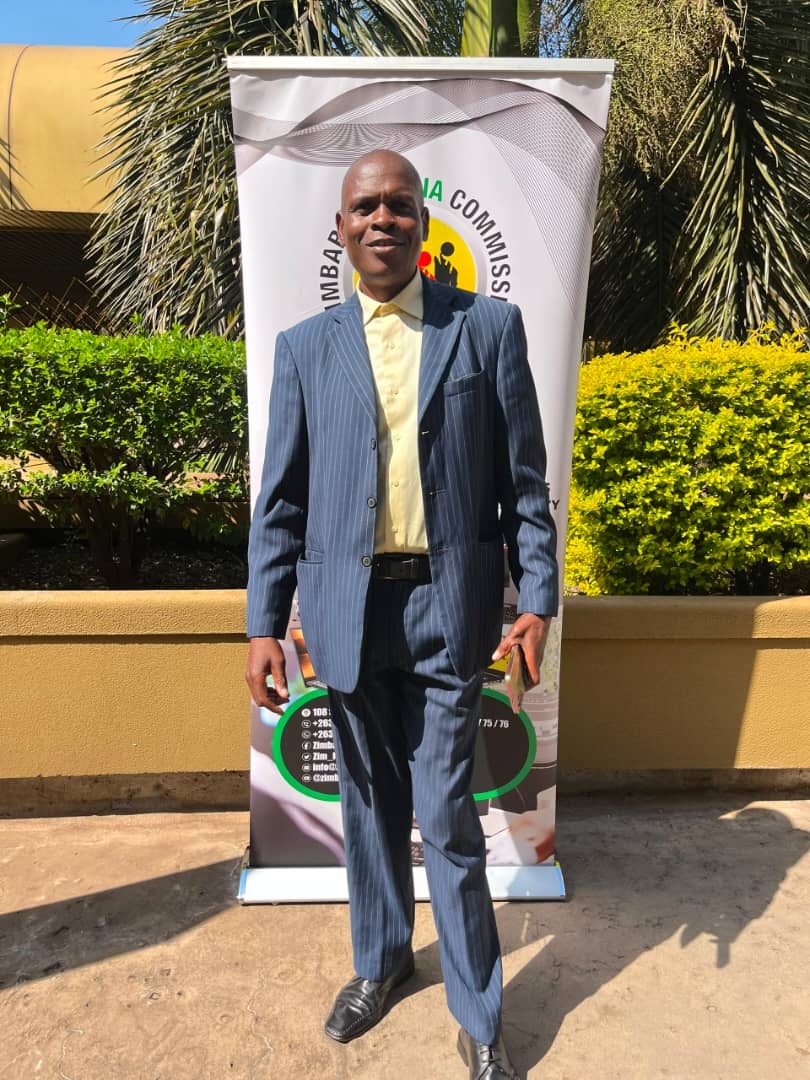
But Chiyedzo Josiah Dimbo, Ambassador of Hope and Founder of SAMACET EYE, stopped the moment.
“Just a quick contribution on that last point, Chair,” he said with a calm smile.
“While we are offering feedback on inclusive reporting for the manual, let’s make sure we use ‘people with disabilities’ instead of ‘people living with disability.’”
“‘Living with’ makes disability sound like a burden or a medical condition someone carries,” Josiah explained. “It reinforces the old stigma — that disability is a tragedy to be endured. ‘People with disabilities’ puts the person first and keeps the language clean and respectful. Since this manual will guide journalists across the country, we should set the right standard — even in passing references.”
The chair nodded. The note went into the master draft.
One word changed. Millions of people seen not as patients, but as citizens.
THE INVISIBLE 2.1 MILLION
That moment matters because behind the grammar is a population Zimbabwe can no longer afford to ignore — neither in its policies nor in its economy.
According to the 2022 Zimbabwe Population Census, 2.1 million Zimbabweans have a disability — that’s 13.7% of the population.
Break it down:
– Women with disabilities: 1.1 million
– Men with disabilities: 1.0 million
– Children under 18: Over 300,000
In cities, growth points, and rural areas across the country, they are farmers, students, vendors, journalists, returnees, parents, and business owners.
Yet when floods hit, when heatwaves spike, when food prices rise, they are the first to be left out of the plan — and the last to be counted in the story.
CLIMATE, FOOD AND ACCESS: THE TRIPLE BURDEN
Zimbabwe’s climate crisis doesn’t affect everyone equally.
For people with disabilities, a drought means more than dry fields. It means:
– Food insecurity: 1 in 3 households with a person with disability reported skipping meals in the last ZimVAC assessment.
– Mobility barriers: Evacuation centres, boreholes, and food distribution points often have no ramps, signage in braille, or sign language interpreters.
– Health risks: Heat and poor sanitation hit people with mobility, visual, and chronic health conditions hardest.
During _Cyclone Idai_, organisations documented that persons with disabilities had 4x less access to early warning information because alerts were not in accessible formats.
“Zero Food Waste starts with zero people left behind,” says Josiah. “If our climate reporting and our food systems don’t include persons with disabilities, then we are wasting human potential.”
THE ECONOMIC DIVIDEND: FROM STIGMA TO STRENGTH
But there is another side to this story — one that statistics often miss.
When people with disabilities are excluded from the economy, the nation loses. A 2023 report by the International Labour Organization estimates that excluding persons with disabilities from the workforce can cost developing countries up to 7% of their GDP. For Zimbabwe, that translates into billions of dollars in lost productivity each year.
Yet across the country, many are already pushing back against that loss.
Take a 42-year-old mother of three from Gutu who lost her sight to glaucoma a decade ago. Today, she runs a thriving small-scale poultry business, supplying eggs to local schools and employing two other women from her community — one of whom also has a disability.
“People see my cane and think I need help,” she says. “But what I really need is a market. I feed children every day. That is my contribution to this nation.”
Her story is not unique. The Zimbabwe National Association for the Welfare of the Disabled reports that an estimated 63% of working-age persons with disabilities are self-employed, often creating jobs for others. From the informal stalls of Mbare to the tobacco fields of Mashonaland, they are driving local economies, paying taxes, and building resilience.
Yet the stigma remains. The language used to describe their work — “informal”, “vulnerable”, “dependent” — often erases their agency. Changing that language is not just about politeness; it’s about economic recognition.
FROM CHARITY TO AGENCY: THE HUMAN FACE OF INCLUSION
The shift in language at Rainbow Towers was small. The shift in mindset is bigger.
Across Zimbabwe, disability organisations are demanding more than sympathy. They want seats at the table — and they are already showing what they bring.
A deaf farmer in Chimanimani now leads a community early-warning group that translates weather alerts into sign language videos on WhatsApp. During Cyclone Idai’s aftermath, her group helped evacuate 40 families — many of them also deaf — because they had access to information in their own language.
“I am not a victim of climate change, ” she signs through an interpreter. “ I am a solution. I help my neighbours. That is humanity.”
This is what inclusion looks like: not as beneficiaries, but as architects of resilience.
WHAT JOURNALISTS MUST DO NOW
The new Climate Change Manual, once validated, will be used to train reporters in every province. Josiah’s intervention ensures it starts with dignity.
The rule is simple:
– Say “people with disabilities.”
– Show their faces, not just their challenges.
– Ask them for solutions, not just stories of suffering.
– Count their contributions — in jobs, in food production, in community leadership.
Because statistics without faces are cold. And faces without statistics are ignored.
Zimbabwe has 2.1 million reasons to get this right. And 2.1 million reasons to profit from it.
As Josiah put it in that room:
“Peace is the foundation for development. Let us protect it.lnclusion is the foundation for resilience. Let us practice it.”