
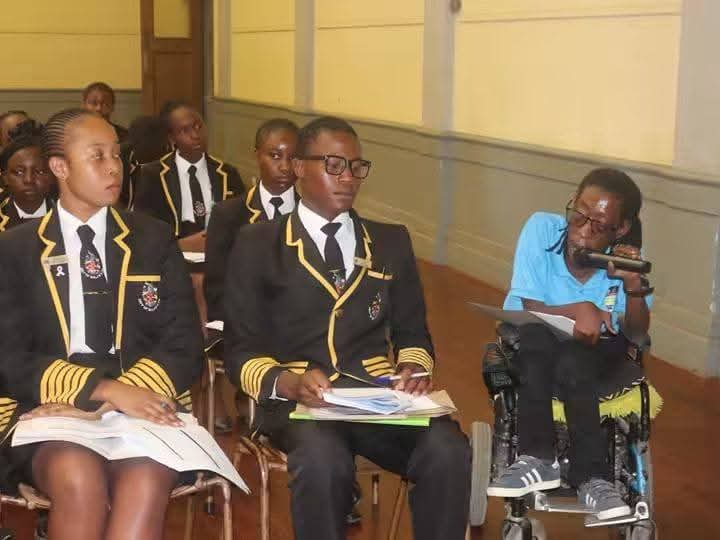
…Tsepang Nare right in wheelchair
By Nyasha Nhau
Disability rights champion Tsepang Nare has challenged the City of Bulawayo to demonstrate its commitment to inclusive development, questioning whether the local authority’s proposed budget adequately reflects the needs and aspirations of persons with disabilities.
In a reflection following a budget consultative meeting held on Tuesday, 20 October 2026, Nare argued that persons with disabilities must be recognised not merely as beneficiaries of public services, but as stakeholders entitled to meaningful participation in decision-making and resource allocation.
He posed a critical question: Does the proposed budget reflect the smart, disability-inclusive city that Bulawayo aspires to become by 2030?
According to Nare, the question was met with what he described as “deafening silence”, raising concerns about the extent to which disability inclusion is prioritised in the city’s financial planning.
Nare cited a proposed budget of US$457 million, with a reported funding shortfall of US$139 million. He further stated that US$8,765 had been allocated towards constructing ramps at youth centres, against a capital expenditure budget of US$130 million.
He argued that the allocation was inadequate given the estimated population of more than 50,000 persons with disabilities in Bulawayo Metropolitan Province, highlighting the need for more deliberate and measurable investment in accessibility and inclusion.
The proposed 74% increase in tariffs also came under scrutiny, with Nare warning that the impact on vulnerable households must be considered, particularly as persons with disabilities face significant barriers to employment and economic participation.
He stressed that disability inclusion should not be treated as an additional financial burden, but as an investment in empowerment, equal opportunities and sustainable economic development.
Nare called for institutional reforms to strengthen disability-responsive public budgeting, including costing disability-related needs, aligning expenditure with the United Nations Convention on the Rights of Persons with Disabilities (CRPD), improving public finance accountability and establishing mechanisms to track disability-related allocations and expenditure.
He also urged Zimbabwe’s whole-of-government approach to development to translate into practical budgetary commitments that enable persons with disabilities to participate in and benefit from development on an equal basis with others.
“Unless it’s recorded, then it was never planned for,” Nare said, underscoring the importance of explicitly incorporating disability inclusion into public financial plans.
He maintained that building an inclusive city requires more than policy declarations, calling for adequate resources, meaningful consultation and accountability in implementing commitments to vulnerable communities.
For Bulawayo to realise its development ambitions by 2030, Nare argued, persons with disabilities must have a voice in decision-making, a seat at the table and a genuine sense of belonging.
His message places disability-responsive budgeting at the centre of the broader debate on local governance, equitable service delivery and inclusive economic growth.