
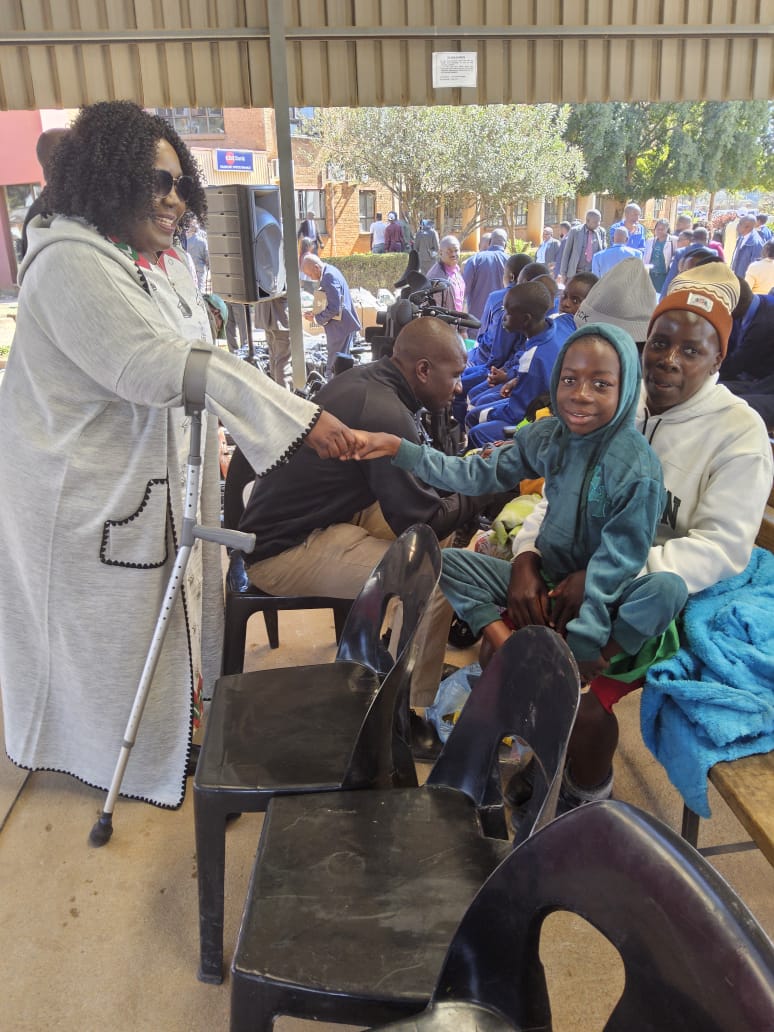
Senator Shiri congratulating a beneficiary of the assistive devices
Stephen Chadenga
For a decade, Precious Shumba had to be carried to school on her mother’s back. For the first time last week Precious wheeled herself to school, courtesy of assistive devices distributed by government to various primary and secondary schools in the Midlands province, in a bid to promote inclusive education and break barriers between students with disabilities and ones without disabilities.
Precious’s mother, Remudzai Zhou applauded government’s initiative saying it was a “major boost” in creating a conduce learning environment for her daughter.
“I am happy that at least she now has mobility and l will not need to always carry her on my back to school,”she said.
Another parent, Privilege Mahambaedwa said that instead of carrying her child to school every morning, she now has more time to fend for the family.
“I now have more time to work for my child and her siblings as she can independently wheel herself to school,”said Mahambaedwa.
The Ministry of Primary and Secondary Education, working with other partners including disability rights advocates distributed the equipment worth thousands of United States dollars that include wheelchairs, magnifiers, crutches, walking cranes, talking calculators, headphones, Jensen recorders, slates and styluses as well as braille abacuses.
Speaking in Gweru at the handover ceremony, Senator representing Persons with Disabilities, Senator Annah Shiri said the devices will assist learners access education in an independent and dignified manner.
“These wheelchairs are not just mobility devices but are steps towards independence, dignity and full participation in society,”she said.
“The tablets are equally important in this digital era where knowledge is power and technology give persons with disabilities access to education, information and economic activities.”
Shiri said while the assistive devices empower the education of learners with disabilities, there was also need for schools to provide disability-friendly infrastructure including accessible ablution facilities.
“We should educate them (learners with disabilities), not seclude them as well as empower them so that they live independently,”Shiri said.
“Disability has been prioritied and mainstreamed into development and we also want to thank government for introducing the Disability Expo which rotates among provinces. These initiatives demonstrate the commitment of the Second Republic, under the leadership of His Excellency the President (Emmerson Mnangagwa), to an inclusive government that leaves no one and no place behind.”
Senator Shiri commended the Midlands saying the province under the leadership of Minister of State for Provincial Affairs and Devolution, Owen Ncube, has set the pace in promoting disability inclusion. She also acknowledged the support from the Office of the President and Cabinet in allocating stands and livelihood projects aimed at empowering persons with disabilities.
Guest speaker at the event, Midlands minister for Provincial Affairs and Devolution Owen Ncube said government launched the National Disability Policy in 2021 to promote equal access to education, healthcare and infrastructure while requiring learning institutions to adapt their curricula and environments to accommodate learners with disabilities.
“In the same vein l also commend the ministry of Higher and Tertiary Education for supporting research into locally produced assistive devices and for establishing an audiological testing laboratory at the Midlands provincial education offices to screen learners for hearing impairments and provide psychometric assessments,”said Ncube.
With this latest development, one can hear the tapping of canes, sound of wheels and braille pages turning in classrooms across Midlands, signalling a new chapter, one where disability is no longer a barrier to learning.