
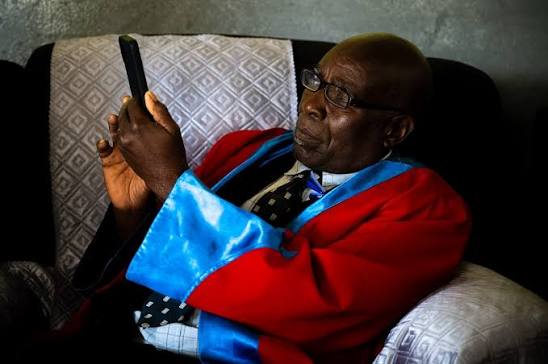
Chief Mposi (pictured)
By Gideon Madzikatidze/Simbarashe Sithole
SANDAWANA, MBERENGWA – In a country where mining relocations often end in bitterness, court battles and broken trust, Sandawana has told a different story.
Local chiefs including Mudavanhu (born Pardon Mudavanhu), Chingoma (born Miklot Chingoma), Mapiravana (born Rungano Wadawareva), Mposi (born Mpangeri Kufazvineyi Edmos), Mahlebadza, Bvute and host communities in Mberengwa have applauded Mutapa Energy Resources, operators of Sandawana Lithium Mine, for adhering to their socio-cultural tenets and values during the relocation of families and the exhumation and reburial of their ancestors to pave way for the lithium project.
For the communities, it was not just about compensation. It was about dignity. About being consulted, not instructed. About being allowed to bury their dead according to their own customs, in their own way, at their own pace.
Speaking during a joint media and parliamentary familiarisation tour, Mutapa Energy Resources Chief Executive Officer, Mr Innocent Rukweza, said the company deliberately refused to impose a boardroom solution on a sacred community process.
“We were responsible to ensuring that we adhered to cultural norms and customs and we made sure that the families affected they were allowed and given that leeway to conduct those services in a manner that they suffered,” said Mr Rukweza.
“So yes the chiefs guided us and the process was done amicably with the involvement of the community.”
Mr Rukweza said Mutapa works hand in glove with local chiefs on all community matters, particularly around customs and norms that apply specifically to the Sandawana area.
“And over and above that we really work hand in glove with our local chiefs. Not only on exhumation but on all the things that we’ve been consulting and being assisted and guided by the local chiefs especially around customs and norms that apply to this Sandawana area,” he said.
That respect came at a cost, and the company did not run away from it. Rukweza disclosed that 69 graves sat in the footprint of the planned plant, at a cost of over US$7,000 per grave to exhume and rebury, a total of over US$483,000.
“Number is about 7,000 US dollars per grave. That’s what it costs us as a company. The whole process is around 7,000 plus per grave. So that’s the cost to exhume one thing,” he said.
For the chiefs, that willingness to pay, to wait, and to listen is what separates Sandawana from the extractive model that has scarred other mining communities.
As custodians of tradition, the chiefs said they took charge of the process from the start to ensure that no family was humiliated and no custom was violated.
Chief Mudavanhu said traditional leadership led the engagements and insisted that dignity and local governance come first.
“As custodians of our traditions, cultural norms and values, we were responsible for leading the engagements. We told the company that our people are not just numbers to be moved. Their dignity must be respected, and our local governance must be prioritised. That is what happened here,” said Chief Mudavanhu.
“We guided every step – from the consultation, to the exhumation, to the reburial. No grave was touched without the family and the traditional leadership agreeing on how it should be done.”
Chief Mahlebadza said the process proved that development can only succeed when traditional leaders are not sidelined.
“We are the custodians of the land and the ancestors who lie in it. If you bypass the chief, you bypass the people. Here, we were not bypassed. We led, we advised, and we made sure the cultural requisites were followed to the letter,” said Chief Mahlebadza.
“That is why there is peace. That is why families agreed. Because their chiefs were in front, protecting their dignity and their customs.”
Chief Mposi said the chiefs made it clear that respect for culture was non-negotiable, and the company listened.
“Our duty is to protect our people’s dignity and our traditional governance. We made it clear from day one: no process will go ahead unless it respects our norms. The company respected that, and we worked together,” said Chief Mposi.
“When a family has to move their loved one, it is painful. But when it is done with respect, with prayer, and with the chiefs leading, the pain is lessened. That is what Sandawana did.”
Beyond the graves, the relocation package is now visible on the ground (completed) and other few infrastructure about to be completed including 104 households resettled, a modern school, clinic and police station, water reticulation and a US$40.6 million service road, under a US$3.3 million Resettlement Action Plan.
For Mberengwa, the message is clear: mining can move forward without trampling on ancestors, without silencing chiefs, and without stripping communities of dignity.
When families lead the ritual, when chiefs guide the protocol, and when the company funds the process fully and transparently, relocation becomes resettlement, not displacement.
Sandawana has set the standard.