
By Desire Tshuma
FRANCISTOWN, Botswana — What was once a dumpsite on the outskirts of Harare is now being sold to Africa as the answer to its waste crisis, and Botswana is the latest country lining up to learn how it was done.
The growing regional interest was on display in Francistown on 5 November 2026, where Geo Pomona Waste Management (Pvt) Ltd released a media brief outlining months of high-level engagement between the two countries and the company’s expanding footprint across the continent.
The engagement has moved from fact-finding visits to formal cooperation, culminating in the signing of a Memorandum of Understanding between Geo Pomona and Botswana’s Ministry of Local Government in Gaborone on 8 October 2026.
It is a framework for cooperation, not an operating contract, but officials on both sides say it is meant to give that ambition practical direction, through feasibility studies, technical learning, capacity building and project appraisal.
The road to the agreement began earlier this year. On 22 April 2026, Botswana President Advocate Duma Gideon Boko toured Geo Pomona in Harare during engagements in Zimbabwe, observing its infrastructure and transformation of the former dumpsite. On 3 July 2026, Vice President Ndaba Nkosinathi Gaolathe undertook a familiarisation visit to the Geo Pomona facility to appreciate its operations and explore cooperation and the sharing of African expertise.
That was followed on 8 September 2026 by a ministerial and mayoral delegation led by Botswana’s Minister of Local Government and Traditional Affairs, Ketlhalefile F. C. Motshegwa, who visited Geo Pomona in Harare with Francistown Mayor Councillor Gaone Majere and other officials. The delegation was briefed on the company’s infrastructure, rehabilitation initiatives and operations.
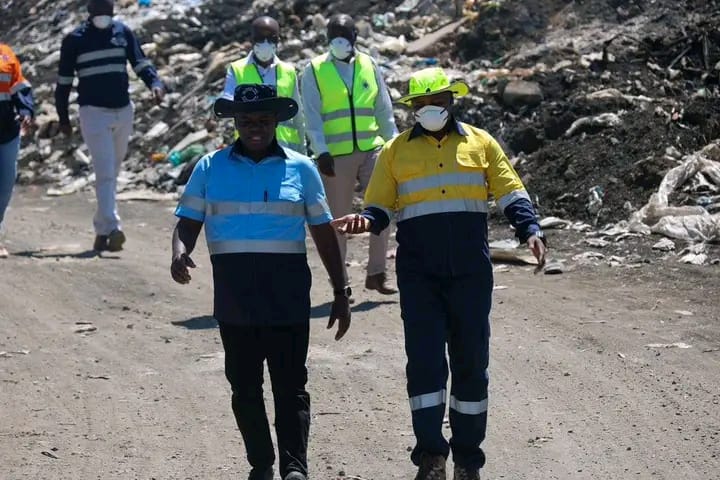
The Francistown visit this week was in many ways a return leg, with Geo Pomona officials now assessing Botswana’s own landfill and waste challenges first-hand.
Francistown Mayor, Councillor Majere, welcomed the delegation, saying the city was determined to lead Botswana in waste management. He told the meeting that Francistown sought to be at the forefront of giving direction to other councils, and that after the assessment of its landfill, the city hoped to receive recommendations from the Government of Botswana on how it can work together with Geo Pomona on waste that has been accumulating at its landfill.
The Mayor explained that Francistown’s landfill also serves surrounding communities and neighbouring towns, making improvement important beyond the city’s immediate boundaries. He said the city was ready to work with engineers to assess the landfill and understand what was required, adding that the city was ready to implement what was agreed upon.
During the technical presentation, the City of Francistown’s Environmental Health Officer outlined the landfill’s existing infrastructure, operations and waste recovery performance. The facility receives household waste, commercial waste, construction rubble and other waste types, and officials acknowledged challenges around recovery and long-term management.
The figures presented in the media pack illustrate the scale of that challenge. Waste recovery at the Francistown landfill was 3.3 percent in 2021 to 2022, 3.0 percent in 2022 to 2023, and 2.8 percent in 2023 to 2024, before improving to 10.7 percent in 2024 to 2025. The Council has set a recovery target of 10 to 12 percent. Recovery work currently involves four companies and nine individuals, while of the landfill’s two compactors, only one is operational.
It is in that context that Geo Pomona’s Harare experience is being closely studied.
Geo Pomona Executive Chairman Dr Dilesh Nguwaya told the media that the company had transformed the former Pomona dumpsite in Harare into a modern waste management facility, with infrastructure that includes engineered landfills, a waste sorting plant, water treatment facilities, weighbridges and recreational amenities.
According to Dr Nguwaya, the company employs more than 1,500 people and has collected more than 620,000 tonnes of waste since February 2025. He said the transformation had been achieved through local expertise, drawing inspiration from President Emmerson Mnangagwa’s philosophy: Nyika inovakwa nevene vayo, a country is built by its own people.
“African problems must be solved by African people. We have the skills in Africa to address our own challenges,” Dr Nguwaya said, in remarks captured in the media pack.
He added: “We have managed to transform what was once a dumpsite into a modern waste management facility that meets international standards.”
“We spoke about turning a shared regional challenge into a shared opportunity, and that is to give that ambition practical direction,” Dr Nguwaya said.
Dr Nguwaya also highlighted the company’s waste-to-energy plans, including proposals to generate electricity from waste, as part of a broader commitment to sustainable waste management and environmental protection.
“We are moving into waste-to-energy, where waste will be used to generate electricity, an important development for waste management in our region,” he said. “Landfills everywhere are a challenge. We need properly engineered landfills to protect the environment and help address climate change.”
The Francistown engagement also highlighted Geo Pomona’s growing regional footprint beyond Botswana.
According to the media pack, the company has signed a number of regional agreements. In Ghana, an MOU was signed with Zoomlion Ghana Limited. In Madagascar, an MOU was signed with the Malagasy State on 4 July 2026. In Botswana, the MOU was signed with the Ministry of Local Government and Traditional Affairs in Gaborone on 8 October 2026, in the presence of President Boko. In Zimbabwe, an MOU was signed with the Ministry of Skills Audit and Development at the Geo Pomona site in Harare on 9 October 2026, for a proposed Centre of Excellence in Waste Management.
Dr Nguwaya said Geo Pomona has also engaged the Governments of Namibia and Madagascar, Ghana, and was preparing to sign another agreement in Kenya. “We have already engaged the governments of Namibia and Madagascar, Ghana, and we are preparing to sign another agreement in Kenya,” he said.
Dr Nguwaya said the company had also engaged the Government of Mongolia, which had expressed interest in Zimbabwe’s waste management experience. A Zimbabwean delegation subsequently visited Mongolia in 2024 for discussions and fact-finding engagements.
Representing Botswana’s Ministry of Local Government, Ms Iye Moakofi welcomed the engagement, emphasising the principle of Batho Pele, People First. She said the approach was to put the needs of the people first, and that the cooperation should be followed by high-level exchanges between the two countries.
“Our Ministry is guided by the principle of Batho Pele, which means People First. In everything we do as a Ministry, we put the needs of the people first,” Ms Moakofi said.
“To say that we were excited and happy about what we saw at Geo Pomona is an understatement,” she said of the September visit to Geo Pomona’s Harare operation.
She explained that the MOU signed in October provides for feasibility studies, technical learning, capacity building and project appraisal. “This Memorandum of Understanding will assist us with feasibility studies, information sharing and technical learning in relation to waste management,” she said, clarifying that the current engagement remains exploratory and that no project approval, procurement or consultancy arrangement has been finalised. Information gathered is intended to inform possible cooperation and is being treated confidentially.
Mayor Majere, who had visited Harare to see the Geo Pomona operation for himself, said the experience had given the city confidence. “Having visited Harare and seen how Geo Pomona is managing its waste, I am confident that we can achieve something similar here in Francistown,” he said.
“I believe that after this visit, Geo Pomona should bring recommendations to the Government of Botswana and the City of Francistown on how we can work together on our landfill,” he added.
While Geo Pomona’s development has attracted public scrutiny and criticism in Zimbabwe, its management model is increasingly drawing interest from institutions beyond the country’s borders.
The growing regional engagement reflects interest in Zimbabwean technology and African-developed solutions to address shared environmental challenges. Presidential and ministerial visits, technical exchanges and cooperation agreements have brought the company’s experience to the attention of countries seeking to modernise waste management.
Dr Nguwaya said the company was open for business and regional skills exchange. “Zimbabwe is open for business, and we have brought our skills from Zimbabwe. Zimbabwe is also open to sharing its expertise and ideas with Botswana,” he said.
“We are here with our engineers to assess the landfill and understand how it is managed. We are ready to implement what we agreed upon and identify opportunities,” he added.
For Botswana, the immediate question is whether the lessons from Harare can be adapted to Francistown’s conditions, its waste volumes and its institutional framework. For Geo Pomona, the Francistown visit is another test of whether a model born out of a Harare dumpsite can be replicated across Africa.
Whether that ambition translates into concrete projects will depend on the feasibility work now underway, and on whether the cooperation moves from exchange visits and memoranda to funded, operational partnerships on the ground.