
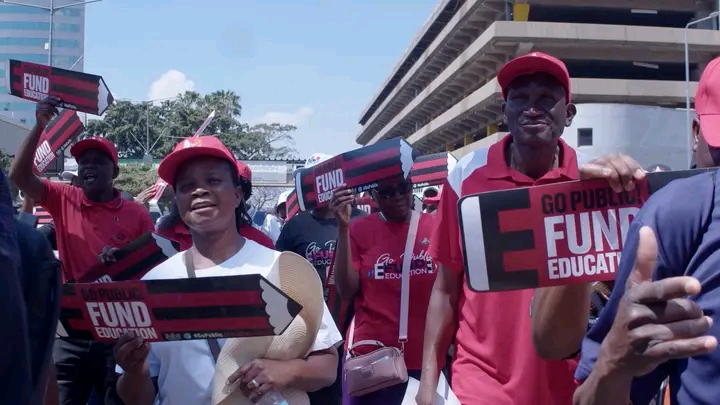
By Simba Matake
The Zimbabwe Teachers’ Association (ZIMTA) has called on the Government to increase education funding to 20% of the national budget and pay teachers a living wage, warning that low salaries, staff shortages and inadequate resources are undermining the country’s education system.
Speaking at World Teachers’ Day commemorations held at Harare Gardens on 10 October 2026, ZIMTA National President Akuneni Maposa said the teaching profession was facing serious challenges despite progress made in expanding access to education.
This year’s international theme, “Standing with teachers: 60 years of protecting the profession, advancing its status and shaping our futures,” marks 60 years since the adoption of the 1966 ILO/UNESCO Recommendation concerning the Status of Teachers.
ZIMTA adopted the local theme, “Stand with Teachers – Go Public! Fund Education,” calling for increased investment in public education and improved working conditions for teachers.
Maposa acknowledged progress made between 2020 and 2024, including an increase in the number of trained teachers from about 128,000 to more than 153,000, growth in early childhood education enrolment from 27% to 43%, and the construction of nearly 2,900 schools.
He also noted that school dropouts had declined by a fifth in 2025.
However, Maposa said teachers’ salaries remained far below the cost of living, with educators earning about 42 cents for every dollar required to meet their families’ basic needs.
“The average Zimbabwean teacher takes home about US$450 a month. ZIMTA’s own consumer basket for a family of five stood at US$1,084 in June 2026,” he said.
He added that only part of teachers’ salaries was guaranteed in United States dollars, while the 2025 job evaluation exercise had downgraded many school heads, deputy heads and teachers. Housing, transport and rural allowances had also been lost, further worsening their financial situation.
ZIMTA said about 6,000 teachers were leaving the service annually, raising concerns about the education sector’s capacity to retain experienced personnel and maintain acceptable standards.
The union said that in July 2025, there were 9,425 vacant teaching posts, but Treasury had approved only 2,000 of the 8,000 posts requested for 2026.
The shortages have contributed to overcrowded classrooms, with early childhood development classes accommodating more than 50 learners against a recommended maximum of 20. Primary school classes have more than 55 learners against a norm of 32, while secondary school classes have between 45 and 60 learners.
ZIMTA said shortages were particularly severe in mathematics, science and technical subjects.
The union also raised concerns over inadequate school infrastructure, saying Zimbabwe was short of about 2,400 schools, while nearly 2,000 satellite schools were still awaiting upgrading.
In some urban areas, schools were reportedly accommodating as many as 2,000 learners in facilities designed for 500, forcing institutions to introduce hot-seating arrangements.
Funding for information and communication technology laboratories was also cut by 72% this year, according to the union.
Maposa said the challenges were reflected in examination outcomes and access to education, with 81 schools recording a zero per cent Grade Seven pass rate and 181 schools recording a zero per cent pass rate at Ordinary Level.
He added that nearly one in five school-age children was out of school.
“These are not the failures of teachers. They are the failures of an under-funded system in which teachers are asked to work miracles,” Maposa said.
ZIMTA said Zimbabwe’s education funding remained below the benchmarks outlined in the Incheon Declaration, which recommends allocating 15% to 20% of the national budget and 4% to 6% of gross domestic product to education.
In 2026, the Ministry of Primary and Secondary Education received ZiG47.4 billion, equivalent to about US$1.55 billion, representing 15.2% of the national budget and 2.8% of GDP.
The union also criticised delays in releasing allocated funds, saying the ministry had spent less than a third of its budget by the end of June 2026.
Of the ZiG5.6 billion allocated to the Basic Education Assistance Module (BEAM), only ZiG85 million, or about 1.5%, had been released by that time, according to Maposa.
On 5 October, ZIMTA submitted a pre-budget proposal to Parliament calling for the education sector’s 2027 allocation to be increased to ZiG67.8 billion, equivalent to about US$2.16 billion, or approximately 20% of the national budget.
The union said the proposed allocation would be an initial step towards achieving equitable access to quality education by 2030.
ZIMTA outlined six key demands, including increased education funding, improved teacher salaries, the recruitment of additional personnel, investment in school infrastructure, timely release of funds and greater involvement of teachers in policy decisions.
The union called for a clear funding roadmap towards allocating 20% of the national budget and 6% of GDP to education.
On remuneration, it proposed a multi-year plan to close the gap between teachers’ salaries and the cost of living by 2030, starting with an additional US$100 per month in 2027. It also called for salaries to be paid in United States dollars or at a guaranteed exchange rate, alongside the restoration of rural, housing and transport allowances.
ZIMTA further demanded that all 9,425 vacant teaching posts be filled in 2027 and that every departing teacher be replaced within 90 days.
On infrastructure, the union called for a published multi-year school construction programme and an increase in annual capital spending towards US$357 million. The programme, it said, should include teacher accommodation, water and solar power infrastructure, laboratories, ICT facilities and the provision of one textbook per learner.
It also urged the Government to establish minimum quarterly funding release thresholds of 25% for BEAM, school feeding programmes, sanitary wear and capital projects.
The final demand was the establishment of a binding collective bargaining forum and the inclusion of teacher organisations in all major education policy decisions.
“When we invest in teachers, we invest in learners. When we fund public education, we invest in Zimbabwe’s future,” Maposa said.
He reiterated the union’s call for the Government to stand with teachers and adequately fund public education.