
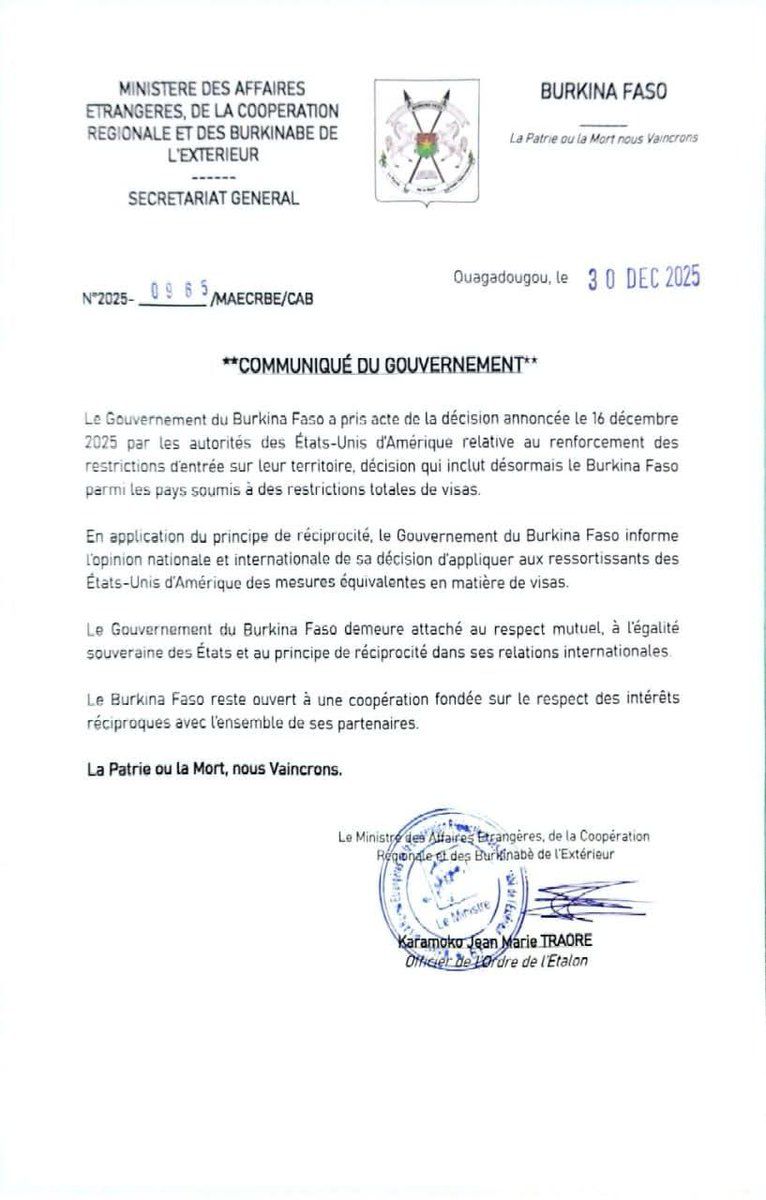
Mali and Burkina Faso said Tuesday they would bar United States citizens from entering their territories, retaliating against a recent decision by US President Donald Trump to impose visa restrictions on their nationals.
The measures were announced in separate statements by the two countries’ foreign ministries and took effect immediately. Officials said the decision was based on the principle of reciprocity, after Washington added Mali and Burkina Faso to an expanded list of countries whose citizens face restrictions on entry into the United States.
“In accordance with the principle of reciprocity, the government of the Republic of Mali will apply the same conditions and requirements to US nationals as those imposed on Malian citizens,” Mali’s foreign ministry said.
Burkina Faso’s foreign minister, Karamoko Jean-Marie Traoré, issued a similar statement, saying his country would mirror the measures taken by the United States against Burkinabe citizens.
The tit-for-tat escalation reflects deepening tensions between Washington and a group of west African military-led governments that have grown increasingly hostile to Western influence. Mali and Burkina Faso, both governed by juntas that seized power in recent coups, have distanced themselves from traditional partners and drawn closer to non-Western allies.
On 16 December, Trump expanded earlier travel restrictions to cover 20 additional countries, including Mali, Burkina Faso and Niger. All three are run by military governments and have withdrawn from the regional bloc Economic Community of West African States, forming a breakaway alliance.
US officials said the expanded restrictions were driven by security concerns and weak information-sharing systems. In a statement announcing the move, the administration said the measures were “necessary to prevent the entry of foreign nationals about whom the United States lacks sufficient information to assess the risks they pose.”
The White House also cited persistent attacks by armed groups across parts of the Sahel as a factor behind the decision. Mali and Burkina Faso have struggled for years to contain jihadist violence linked to groups affiliated with al-Qaida and the Islamic State, which has displaced millions and killed thousands across the region.
The travel restrictions represent a further tightening of Trump’s hardline immigration policy following a 26 November shooting in Washington, DC, in which two members of the National Guard were wounded. US officials pointed to the attack as justification for strengthening border and visa controls, although they did not link the suspects directly to the newly restricted countries.
Military leaders in Mali and Burkina Faso have repeatedly blamed insecurity on the failure of previous civilian governments and Western-backed counterterrorism strategies. Since taking power, the juntas have pledged to defeat armed groups while asserting national sovereignty, including curbing Western military presence and cooperation.
Relations between the Sahelian governments and the United States have steadily cooled, with Washington reducing military engagement and warning about human rights abuses and democratic backsliding following the coups.
Tuesday’s announcements underscore how quickly diplomatic rifts have widened, with travel and visa policies becoming another front in the standoff between Washington and west Africa’s military-ruled states.
Kukurigo Updates©️