
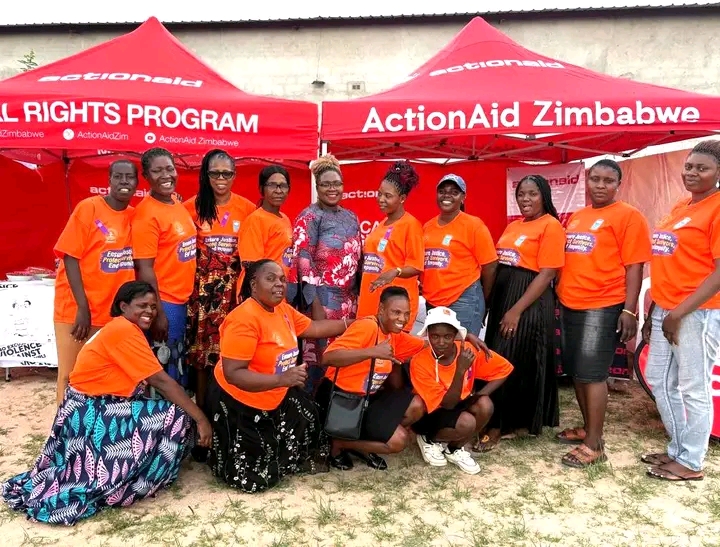
Women’s economic empowerment has emerged as a critical weapon in the fight against gender-based violence, with ActionAid Zimbabwe highlighting how access to productive resources, skills and sustainable livelihoods can help women overcome financial dependence and challenge inequalities that expose them to abuse.
The organisation showcased its community-based economic empowerment initiatives during the national launch of the 2026 16 Days of Activism Against Gender-Based Violence campaign held at Murehwa Council Grounds in Mashonaland East Province on 25 November.
Working with women farmers from its Rural Women’s Assemblies in Chiendambuya, Nyazura and Mbire, as well as young women from Hopley, ActionAid Zimbabwe exhibited agroecological products, livestock and other livelihood initiatives demonstrating the role of economic independence in strengthening women’s resilience.
The initiatives illustrate how equipping women with agricultural skills, productive resources and opportunities to generate income can improve household food security while enabling them to become financially independent.
Economic dependence remains one of the structural inequalities that can increase women’s vulnerability to gender-based violence, particularly economic abuse, where perpetrators use financial control and limited access to resources to undermine women’s independence and decision-making.
By supporting women to establish sustainable livelihoods and participate in economic activities, ActionAid Zimbabwe is promoting an approach that addresses not only the consequences of gender-based violence but also some of the underlying conditions that perpetuate it.
The importance of this approach was underscored by Zimbabwe’s Minister of Women Affairs, Community, Small and Medium Enterprises Development, Hon. Monica Mutsvangwa, and Mozambique’s Minister of Labour, Gender and Social Action, Hon. Ivete Ferrão Alane, who visited the organisation’s exhibition stand during the launch.
Their visit highlighted the importance of investing in women’s economic empowerment as part of broader efforts to advance gender equality and tackle the structural inequalities that contribute to gender-based violence.
The national campaign was officially launched in partnership with the Ministry of Women Affairs, Community, Small and Medium Enterprises Development and various civil society organisations.
Speaking at the event, Hon. Mutsvangwa called for a whole-of-society approach to ending gender-based violence, emphasising the need to translate awareness into action and commitments into accountability.
“We are here together to strengthen our response because we want a nation which has got zero tolerance to gender-based violence,” she said.
Her Mozambican counterpart, Hon. Alane, called for stronger regional cooperation between Zimbabwe and Mozambique, urging the two countries to transform the 16 days of activism into 365 days of sustained action against gender-based violence.
The emphasis on economic empowerment reflects the growing recognition that ending GBV requires interventions that go beyond awareness campaigns and legal protections to address the social and economic inequalities that leave women vulnerable.
ActionAid Zimbabwe’s initiatives demonstrate the importance of placing women’s economic rights, leadership and access to productive resources at the centre of gender equality efforts.
As the 2026 16 Days of Activism campaign continues, the message from Murehwa is that empowering women to achieve financial independence is an important step towards building safer communities and reducing their vulnerability to abuse.