
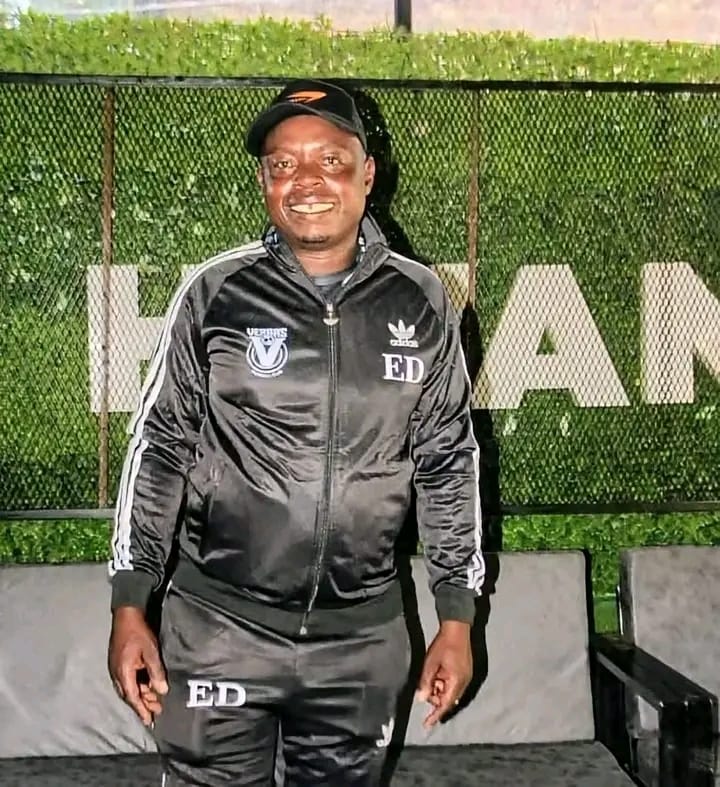
By Desire Tshuma
HWANGE — On an ordinary Wednesday afternoon, in the middle of a lunch break in Hwange, a man who once stood between the posts for one of Africa’s proudest clubs fell to the ground and never got up again.
That man was Edmore Sibanda (pictured).To the football world, he was MaMkhwebu. To the young players he was coaching at Vergas FC, he was simply coach. To Highlanders supporters who watched him from 1999 to 2004, he was the fearless keeper in black and white who never hid from a challenge.
His sudden collapse has left a community struggling to understand how a man who seemed fine while eating with workmates could be gone minutes later. He was taken to a nearby clinic, but the help came too late.
There is a particular cruelty in the timing. Highlanders, Bosso, iBosso, turned 100 this year. A hundred years is supposed to mean celebration. Parades. Old players returning. Stories retold with laughter. Instead, for much of 2026, Barbourfields has felt more like a place of mourning than a place of jubilation.
Sibanda is not the first goalkeeper Bosso has lost in recent seasons, and that is part of what makes this moment so heavy. The position that demands the most courage on the field seems to have carried the most sorrow off it.
Just a few months earlier, in July, the club said goodbye to Njabulo Nyoni, known to many as Popo. He had come through the tough football grounds of Cement Siding and worked his way to Highlanders and Chicken Inn. Those who knew him spoke of a quiet, disciplined man who loved the game without making noise about it.
Two years before that, in 2024, another keeper, Takunda Mutanga, passed on. His time at Highlanders was brief, just a single league appearance, but his death reminded supporters how fragile a football career can be, and how quickly a young life can fade from the terraces.
Go further back and the name William Chirwa still brings respect. The older generation called him Gorilla, not out of mockery, but out of admiration for his size, his reach and his bravery. He died at 85 after a long battle with illness, closing a chapter that stretched back to the 1950s when he began playing in Zambia.
Sibanda’s story fits into that line, but it also fits into a much larger and more painful story that has defined Bosso’s 100th year.
This was meant to be the year the club, founded in 1926 in Makokoba by two brothers who wanted football to unite a people, looked back with pride. Instead, the year has been marked by one funeral after another.
In April, seven supporters died at Mawabeni after stopping at the scene of an earlier crash, only for another vehicle to plough into them. They had gone to watch football. They never made it home.
In July, the blow landed at the very top of the club. In a single accident on the road back from a league match against ZPC Kariba, Bosso lost its chairman, its vice-chairman, its treasurer and a loyal supporter. Four lives, four families, one night. The stadium that usually roars became silent as thousands gathered to say goodbye together.
The four who perished in that Kariba trip were Chairman Retired Colonel Kenneth Mhlophe, Vice-Chairman Sifiso Siziba, who was also the Warriors security officer, Executive Committee Member responsible for Finance Nkani Khoza, and devoted club member and supporter Mbalenhle Sibanda. They died at Lochard in Insiza along the Bulawayo-Gweru Road when their vehicle struck a cow before colliding with an oncoming bus.
President Emmerson Mnangagwa accorded all four State-assisted funerals, and they were honoured with a joint funeral service at Barbourfields Stadium before burial. It was a moment that showed the whole nation how deep the Bosso wound was, with government officials, football administrators, players and supporters standing together in grief.
August brought no relief. The club lost a long-serving finance officer who had been part of its daily life for two decades. Days later, it lost its elderly patron. Then, on a Sunday night after a 2-0 win over Herentals, six more supporters died on the road to Filabusi when their vehicle hit the back of a truck. A win had turned into a wake.
When you add those numbers together, you begin to understand why many Bosso fans speak of 2026 not as a celebration, but as a test of faith.
And yet, the grief of this year did not start in 2026. Bosso has been carrying loss for years.
In 2021, the club lost Ndumiso Gumede, a man many described as the conscience of Highlanders. He was a teacher, an administrator, a storyteller and a fierce protector of the club’s constitution and assets. He believed Bosso should be run properly, with audited accounts and real meetings, not rumours. When his tombstone was unveiled years later, it was shaped like a Bosso shirt, because for him, the club was not a job. It was an identity.
In late 2025, the club lost Godfrey Muzanenhamo, a former player, in a violent attack while he was doing community patrol work in Emakhandeni. In that same period, it lost its beloved bouncer, Bhibhiza, a man who had stood at the gate for years, greeting fans, keeping order and becoming part of the matchday ritual. And it lost Martin Ndlovu, a midfielder from the 1980s who went on to spend 15 years coaching young players in Lupane.
Older supporters still carry the memory of Adam Ndlovu, the striker whose goals lit up the national team in the 1990s, dying in a crash near Victoria Falls in 2012. That loss still feels fresh because Adam represented what Bosso could produce: talent, fearlessness and pride.
So what do we do with all this grief?
For Highlanders, the answer has always been the same: keep going. Keep showing up. Keep singing. Keep filling Barbourfields. The club was born in a township, built by ordinary people, and kept alive by ordinary people. Its strength has never been money or facilities. It has been belonging.
MaMkhwebu understood that. He was not a superstar. He did not play in Europe. He did not have a long list of trophies. But he wore the jersey, he stood in goal when it mattered, and after his playing days, he went back to the grassroots to teach the next generation. That is the Bosso way.
In Hwange, his former teammates are still trying to make sense of it. In Bulawayo, supporters who watched him in the early 2000s are sharing old memories. In Vergas, young players who looked up to him are now without their coach, just weeks after losing a young goalkeeper of their own.
A hundred years is a long time. It is long enough to build legends. It is also long enough to bury many of them.
If there is anything to take from this painful centenary, it is that Highlanders is not just a football club. It is a family that grieves together, buries its own together, and then, somehow, finds a way to return to the stadium together.
MaMkhwebu has now joined that family of the departed. The goalposts at Barbourfields will stand a little quieter without him. But his story, like the stories of all those lost in this centenary year, will remain part of what makes Bosso, Bosso.