
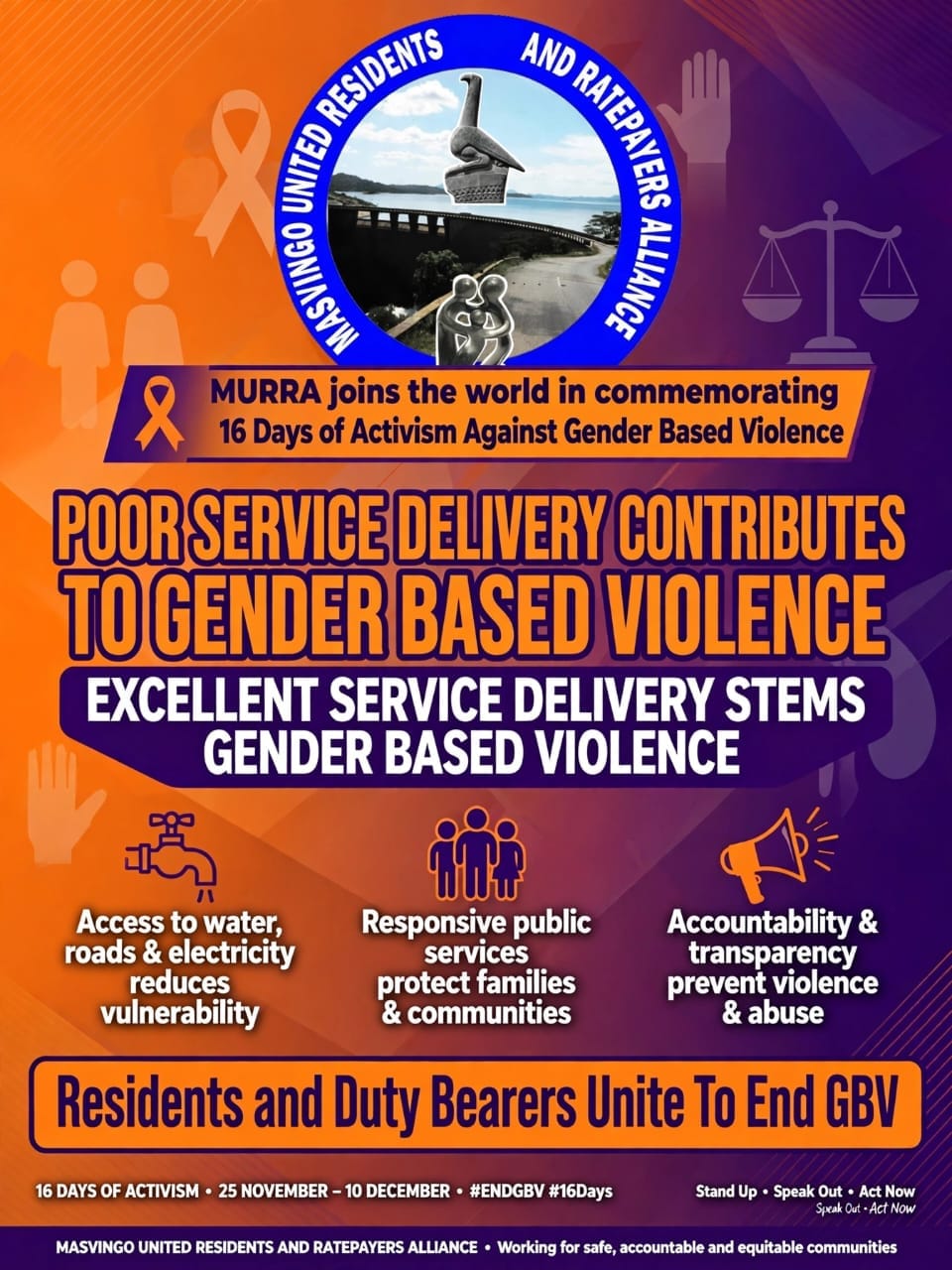
MASVINGO -The Masvingo United Residents and Ratepayers Alliance (MURRA) has called for improved public service delivery as part of efforts to combat Gender-Based Violence (GBV), warning that inadequate access to water, electricity, roads and other essential services exposes women and girls to increased risks of abuse and exploitation.
The organisation said poor service delivery was an often-overlooked contributor to GBV, particularly in high-density suburbs, peri-urban settlements and rural communities where women and girls frequently encounter unsafe conditions while accessing basic services.
In its message marking the 16 Days of Activism Against Gender-Based Violence, running from 25 November to 10 December, MURRA Director Anoziva Muguti said providing essential services was not merely a development responsibility but also an important measure for protecting women and girls.
“Poor service delivery contributes to Gender-Based Violence. When women and girls are forced to walk long distances to fetch water, travel on unsafe roads, or move around in darkness because there are no street lights, their vulnerability increases. Excellent service delivery stems Gender-Based Violence,” said Muguti.
Under its local campaign message, *“Residents and Duty Bearers Unite To End GBV,”* MURRA is urging communities, local authorities and government institutions to recognise the relationship between service delivery and the safety of vulnerable groups.
Muguti said unreliable water supplies often forced women and girls to leave their homes during unsafe hours in search of water, exposing them to potential harassment and sexual violence.
He added that poor road networks and inadequate public transport could leave women stranded or compel them to walk long distances through unsafe areas.
The absence of reliable electricity and functioning street lights also increases security risks, creating environments where violence and abuse can occur without being easily detected.
“Access to water, roads and electricity reduces vulnerability. When water is available at home, a woman does not have to wake up at 3am to queue at a distant borehole. When roads are passable and street lights are working, girls can walk to school and women can go to work without fear,” he said.
MURRA further emphasised the importance of accessible public institutions, including health facilities, police stations, safe houses and community centres, in ensuring that survivors of GBV receive timely assistance.
Muguti said survivors needed responsive institutions where they could report abuse and access medical, psychosocial and legal support without intimidation or unnecessary delays.
“When a survivor reports violence, she must find a police officer who listens, a clinic that is open, a social worker who is available, and a local authority that acts. If those services are absent, delayed or hostile, survivors are silenced and perpetrators are emboldened,” he said.
The organisation also raised concerns over inadequate accountability and transparency in public administration, arguing that poor governance and the exclusion of women from decision-making processes further undermine efforts to address GBV.
Muguti said women, despite being the primary users and managers of household services, were often marginalised in discussions concerning municipal budgets, water allocation, housing and urban planning.
He called on local authorities and other duty bearers to adopt gender-responsive budgeting and ensure that the needs and safety of women and girls were considered when planning and implementing development projects.
“A council that fixes burst pipes, maintains street lights, clears overgrown paths and ensures clean public toilets is already fighting GBV, even if it does not realise it. That is the connection we want duty bearers to understand,” Muguti said.
MURRA urged residents to hold public officials accountable for the use of public funds while encouraging authorities to prioritise water provision, road rehabilitation, street lighting, refuse collection and the maintenance of safe public spaces.
The organisation called on the City of Masvingo, government ministries, councillors, traditional leaders, law enforcement agencies, health officials and development partners to work together in addressing the root causes of GBV.
It also encouraged communities to challenge harmful practices, speak out against abuse and avoid normalising violence within households and neighbourhoods.
The 16 Days of Activism Against Gender-Based Violence is an international campaign observed annually from 25 November, the International Day for the Elimination of Violence Against Women, to 10 December, Human Rights Day.
MURRA said efforts to end GBV should extend beyond awareness campaigns and address underlying challenges such as poverty, inequality, harmful cultural practices and inadequate public services.
“The 16 Days of Activism must not end on 10 December. The fight against GBV must continue in our homes, in council chambers, in our budgets and in our daily decisions about services,” Muguti said.
The organisation urged residents to Stand Up, Speak Out and Act Now, emphasising that safe, accountable and equitable communities were essential to ending gender-based violence.