
By Desire Tshuma
HARARE — Government has called for the meaningful involvement of persons with disabilities in national policy formulation, decision-making and economic development, saying inclusion must go beyond symbolic representation to giving affected communities the power to shape decisions that determine their lives.
Deputy Minister of Women Affairs, Community, Small and Medium Enterprises Development, Kiven Mutimbanyoka, who represented Minister Monica Mutsvangwa, said persons with disabilities must be recognised as equal partners in national development rather than passive beneficiaries of government programmes.
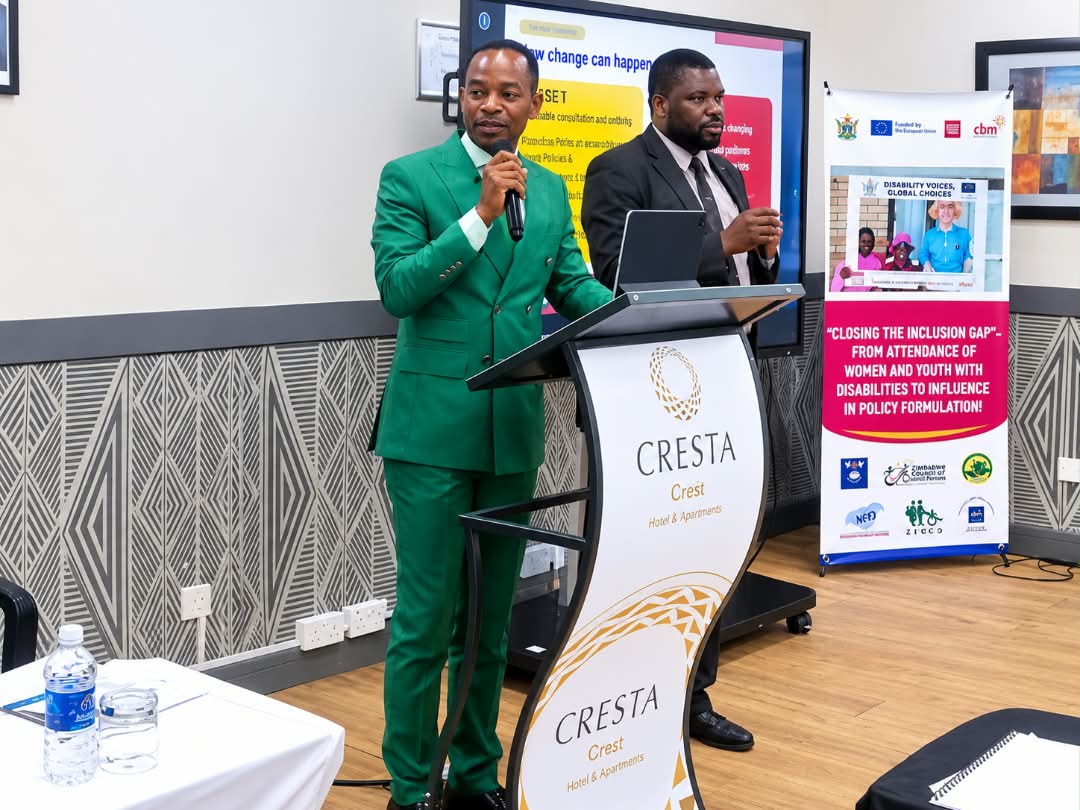
Addressing the inaugural annual learning conference organised by the Leonard Cheshire Disability and six partner organisations of persons with disabilities, Mutimbanyoka said the principle of “Nothing about us without us” must guide the country’s approach to disability inclusion.
“Nothing about us without us. Five simple words, yet they carry an entire philosophy of equality, dignity and self-determination. They underscore the fundamental principle that those most affected by policy must be a meaningful voice in its conception, formulation and implementation,” he said.
He stressed that genuine inclusion should be measured by the extent to which the experiences and perspectives of persons with disabilities influence government policies, national priorities and development programmes.
“There is a world of difference between being afforded a seat at the table and having a voice in shaping the decisions made around it. Our understanding of inclusion must therefore transcend the mere presence of persons with disabilities at consultations, conferences and public engagements. It must be reflected in the extent to which their perspectives inform policy, their recommendations influence decisions and their aspirations find expression in our national development priorities,” Mutimbanyoka said.
He challenged government institutions and development partners to move beyond the appearance of representation towards substantive participation, describing persons with disabilities as entrepreneurs, professionals, academics, innovators and leaders whose potential remains critical to Zimbabwe’s development.
“Our responsibility as government and development partners is not to prescribe the limits of their potential, but to dismantle the barriers that stand in the way of its full realisation,” he said.
Mutimbanyoka said Zimbabwe had established an important constitutional and legislative framework for protecting the rights of persons with disabilities, citing Sections 22 and 83 of the Constitution, the National Disability Policy and the Persons with Disabilities Act of 2025.
However, he cautioned that legislation alone was insufficient unless translated into practical opportunities, accessible public services and institutional reforms.
“The true measure of our commitment cannot rest solely upon the strength of our legislative instruments or the eloquence of our policy declarations. It must ultimately be discernible in the opportunities we create, the barriers we dismantle and the lives we transform,” he said.
He called for disability inclusion to be integrated into national planning, policy formulation, budgeting and service delivery, emphasising that responsibility should extend across all government ministries and institutions rather than being confined to a single department.
The Deputy Minister also highlighted the challenges confronting women and girls with disabilities, who often experience multiple forms of discrimination arising from both gender and disability.
He said such challenges included limited access to education and healthcare, increased vulnerability to gender-based violence, economic exclusion and inadequate representation in leadership and decision-making structures.
“We must, therefore, cultivate a society in which a woman’s disability never becomes a measure of her worth, a limitation upon her aspirations or a justification for denying her opportunities,” he said.
Mutimbanyoka said young persons with disabilities should equally be recognised as active participants in shaping Zimbabwe’s future, adding that their contributions must be reflected in youth development and national economic empowerment programmes.
He said his ministry was championing the economic inclusion of women and young persons with disabilities through cooperatives, small and medium enterprises development and community initiatives.
Access to finance, productive resources, skills development, markets and business opportunities, he said, should be deliberately extended to persons with disabilities.
“They must be architects of development, not simply recipients of its rewards,” he said.
Mutimbanyoka further urged institutions to ensure that disability inclusion was reflected throughout the entire policy cycle, from identifying national priorities and formulating policies to implementation, monitoring and evaluation.
He invoked Article 4(3) of the United Nations Convention on the Rights of Persons with Disabilities, which obliges State Parties to closely consult with and actively involve persons with disabilities, including children, through their representative organisations in decisions affecting them.
He called for accessible infrastructure, sign language interpretation, assistive technologies, appropriate communication formats and reasonable accommodation to ensure that persons with different disabilities could participate meaningfully in public consultations and national programmes.
Organisations of persons with disabilities, he added, should be recognised as indispensable development partners whose institutional capacity, representation and contributions deserved greater support.
The Deputy Minister challenged the conference to translate its discussions into a practical programme of action backed by clearly defined responsibilities, designated focal persons and realistic implementation timelines.
“As we journey towards Vision 2030, let us remember that a nation cannot rise to its full height whilst the potential of its people remains unseen, unheard and unrealised. Our ambition must be a Zimbabwe where disability does not define destiny, where gender does not limit possibilities and where every citizen has the power to shape the nation’s future,” he said.
He said the ultimate measure of inclusion would be reached when people who had historically been excluded from decision-making became active authors of the country’s development agenda.
The conference brought together government representatives, civil society organisations, development partners, academia, the private sector and the media to reflect on strengthening the participation of persons with disabilities in national development.
Mutimbanyoka commended Leonard Cheshire Disability Zimbabwe and its six partner organisations for their work in advancing disability inclusion and strengthening civic participation.
He also acknowledged the contribution of CBM Global Disability Inclusion and support from the European Union towards the initiative.
He expressed hope that the conference would mark a turning point in transforming disability inclusion from policy commitments into measurable action.