
By Bigboy Madzivanzira
Zimbabwe has good laws for persons with disabilities. But on the ground, for women and youth with disabilities, those laws are still mostly on paper.
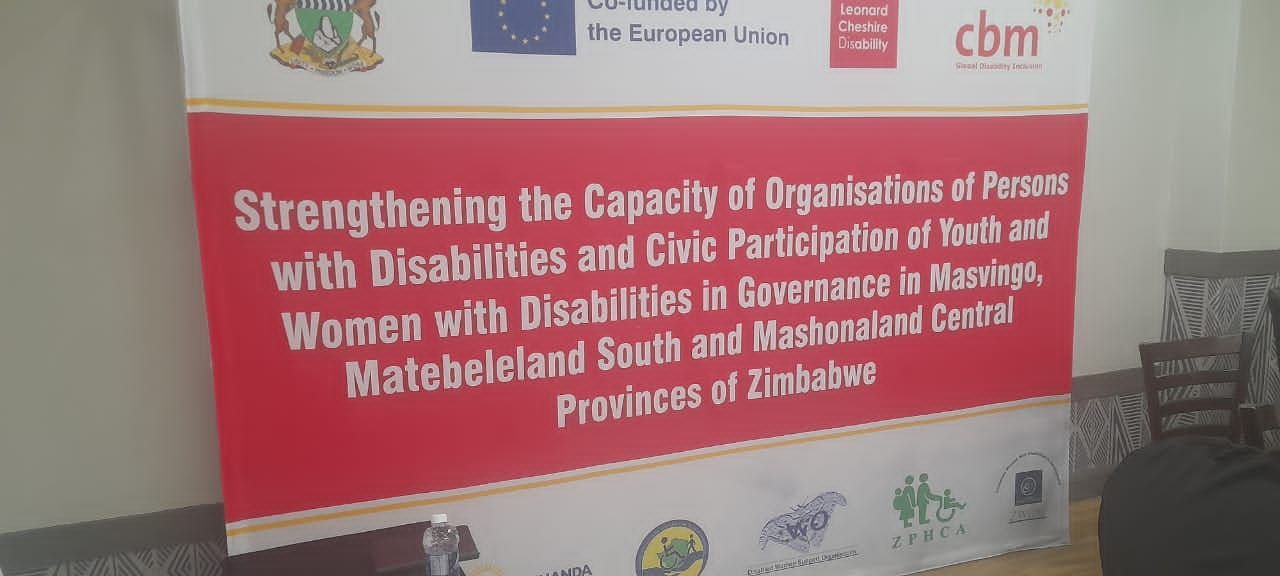
That is the message from a new Policy Brief by Leonard Cheshire Disability Zimbabwe, released this year, based on research carried out in February 2026 in Masvingo, Matabeleland South and Mashonaland Central.
The brief is titled: “Closing the Inclusion Gap: Centering Women and Youth with Disabilities in Zimbabwe’s Policymaking Processes.”
It is supported by CBM Global, and co-funded by the European Union and CBM Ireland.
Good Laws, Poor Practice
Zimbabwe’s Constitution – Sections 6, 22, 83 and 120 – guarantees rights for persons with disabilities. The country also has the National Disability Policy of 2021, and the new Persons with Disabilities Act (Act 3 of 2025).
But the research found a big gap between what the law says and what happens in real life.
Women and youth with disabilities are not in the rooms where decisions are made.
> “We are called when they want numbers, not when decisions are made.” Woman with disability, Gutu
That one sentence sums up the whole brief.
People are mobilised for food aid, or for registration. They are not mobilised for planning, for budgets, for policy.
Guest of Honour: From A Seat To A Voice
Delivering the keynote as Guest of Honour, Deputy Minister of Women Affairs, Community, Small and Medium Enterprises Development, Hon. Kiven Mutimbanyoka, challenged Government to move beyond inviting persons with disabilities to conferences, and give them real power to shape public policy, budgets and the national development agenda.
He said inclusion must mean more than a seat at the top table:
> “There is a world of difference between being afforded a seat at the table and having a voice in shaping the decisions made around it.” Hon. Kiven Mutimbanyoka
Child President: Attendance Is Not Influence
His Excellency the Child President of the Republic of Zimbabwe delivered one of the most powerful speeches of the day, at Cresta Oasis, Harare.
He warned the conference against ceremonial inclusion:
> “Attendance is not influence. Representation is not necessarily participation. And participation, unless accompanied by meaningful decision-making power, risks becoming nothing more than a ceremonial exercise.”
He said Zimbabwe must move beyond the politics of invitation:
> “We must cease treating inclusion as an act of generosity and begin recognising it as an obligation of justice.”
On young people, he was clear:
> “Young people are not merely leaders of tomorrow. We are contributors to the present.”
And in his closing, he gave the conference its moral test:
> “Inclusion without influence is incomplete democracy, representation without participation is an empty promise, and development without equality is development unfinished.”
He also challenged policymakers to produce more than resolutions:
> “Let this conference produce more than resolutions. Let it produce institutional reforms, measurable outcomes and a renewed determination to close the inclusion gap.”
A Challenge From The Floor: Why So Few Stories?
During the discussions, Shepherd Nyathi of ZWIDE challenged journalists in the room, asking why there are so few stories reporting on persons with disabilities.
Responding as both Chairperson of Disabled Women Support Organization and as a Freelance Journalist attending the conference, Bigboy Madzivanzira said the problem is not lack of interest, but lack of capacitation:
> “Journalists are not capacitated on disability or health journalism, hence organisations need to involve them more.”
He said if organisations want more and better coverage, they must invite journalists early, train them on disability language and rights, and give them access to stories, data and voices from the community — not just invite them to cover an event at the end.
Rural Areas Are Hit Hardest: The Call From CAN Africa Network
Speaking during the discussion on inclusion, Bigboy Madzivanzira said the people most hit by exclusion are persons with disabilities in the rural areas.
Speaking as Zimbabwe Country Representative of CAN Africa Network, he said if organisations working in disability come together, information sharing alone can change lives.
He gave a practical example:
> “Imagine areas like Rushinga or Mt Darwin — if a person wants a wheelchair they are required to have three quotations. Schools are not accessible. Policies need to be enforced.”
He said Zimbabwe does not lack policies. What is lacking is enforcement, coordination and information sharing.
If organisations shared who has wheelchairs, who has assistive devices, who is building accessible schools, and who is working in which district, rural persons with disabilities would not be left to struggle alone.
The Numbers That Should Shock Us
– 56% of women and youth with disabilities have *never been invited* to a policy consultation.
– 80% unemployment rate among persons with disabilities.
– 74.1% of persons with disabilities are living in poverty.
And when Zimbabwe leaves these citizens out, the country loses. The brief estimates that exclusion costs Zimbabwe up to *7% of GDP* in lost workforce potential.
This is not charity. This is economics. This is development.
Accessibility Is Still An Afterthought
Only 7.9% of participants said they got sign language interpretation at consultations. Only 5.3% got Braille or large-print materials.
Venues have no ramps. Transport is too expensive. Information comes too late.
> “The meeting is announced, but the building is upstairs and there is no sign language.” – Youth using a wheelchair, Matobo
How can a person participate if they cannot even enter the room, or understand what is being said?
Triple Burden For Women And Girls
A woman with a disability in a rural area faces three barriers at once: being a person with disability, being a woman, and being rural.
Youth with disabilities are almost absent from ward-level leadership. Caregivers – mostly women – are sidelined, even though they carry the daily burden of care.
35% of respondents said they have low confidence on where to seek help when their rights are violated.
In rural areas, gender-based violence is often handled by family mediation, not by police or Victim Friendly Units. That leaves women and girls with disabilities unprotected.
OPDs Are Trusted, But Not Supported
Organisations of Persons with Disabilities – OPDs – are the most trusted actors in communities.
But the brief says they are underfunded, have weak governance systems, and have no real place in government processes.
They are asked to mobilise people, but they are not given a seat at the table to decide.
What Must Change Now?
1. Binding Accessibility Standards
Every consultation must have sign language, Braille, Easy Read and audio formats, accessible venues, advance notice, and budgeted reasonable accommodation.
2. Guarantee OPD Participation in Governance
Every ministry must show how OPDs were engaged, and how their input shaped decisions. There must be annual Joint OPD-Government platforms before and after the national budget.
3. Strengthen Accountability and Redress
Accessible complaints systems. Data that shows sex, age and disability in all reports. Stronger referral systems for GBV and rights violations in rural areas.
The Time To Act Is Now
Zimbabwe is now implementing NDS2 (2026-2030) – the National Development Strategy 2.
In the first 0-6 months, what is needed is not big money. What is needed is political will – ministerial directives that make inclusion mandatory, not optional.
From tokenism to meaningful participation. That is the journey Zimbabwe must now take.
If women and youth with disabilities are not at the table, then the table is not complete.
About the Author
Bigboy Madzivanzira is the Founder and Director of Health Promotion Clinic Trust, the Chairperson of Disabled Women Support Organization, Board Secretary of Isheanesu Multipurpose Skills Training Centre for children with disabilities and Zimbabwe Country Representative, CAN Africa Network. He is a Medical Rehabilitation Practitioner registered with the Medical Rehabilitation Practitioners Council of Zimbabwe, a Health Promotion Practitioner registered with the Allied Health Professions Council of Zimbabwe, a Family Therapist and a Freelance Journalist accredited by the Zimbabwe Media Commission. Bigboy writes about disability inclusion, Health Promotion and Public Health and social justice. He can be contacted on 0773 367 913 or email him on healthpromotionclinic@gmail.com.