
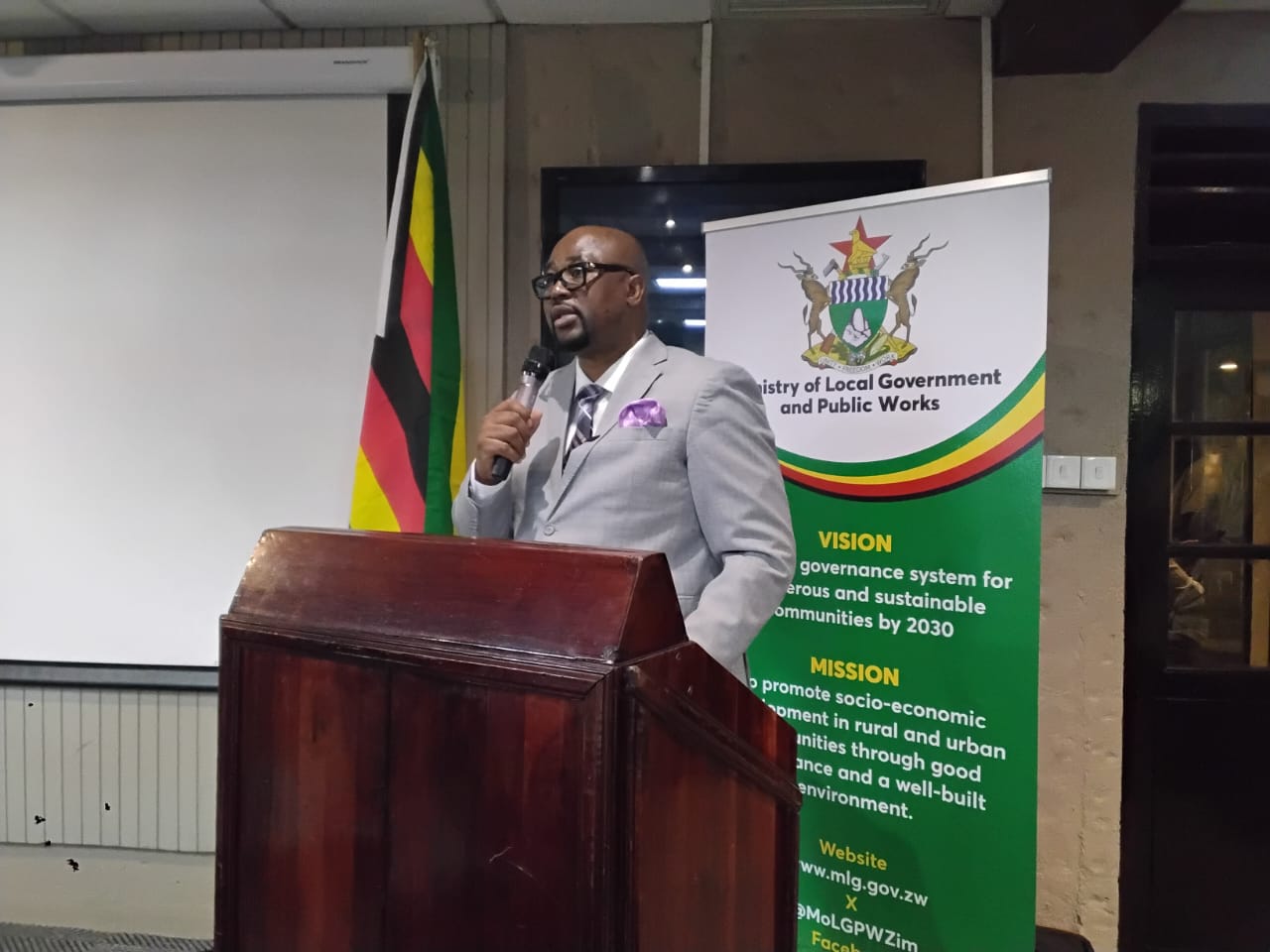
By Desire Tshuma
Harare — Permanent Secretary for Local Government and Public Works, Engineer Tafadzwa Muguti, has urged traditional leaders to follow established administrative channels when raising issues with Government, while warning against illegal land allocations and unbecoming conduct.
Speaking at an interface meeting with Chairpersons of Provincial Assemblies of Chiefs, Local Government Services Directors and District Development Coordinators in Harare on Tuesday, Muguti said the meeting was aimed at enhancing interaction, communication and collaboration between the Ministry and chiefs.
He said traditional leadership cuts across all facets of governance and remains a vital link to the grassroots. He said the President’s mantra, “Nyika inovakwa nevene vayo,” can only be fulfilled when chiefs and their lower hierarchies are incorporated into the system of government.
Muguti said Village Development Committees, Village Assemblies, Ward Assemblies and Ward Development Committees foster collaboration between different tiers of Government, engage citizens in decision-making, promote local economic development and support Government development programmes in line with the devolution agenda.
He outlined the key roles of traditional leaders, including promotion and preservation of culture and heritage, environmental protection and natural resources preservation, socio-economic development and institutional capacity development. Chiefs mobilise communities to participate in community development, promote education, health and sanitation, encourage good farming methods and improve food production. They also protect forests, conserve water, prevent veld fires and avoid environmental destruction.
Traditional leaders also resolve conflicts, settle disputes, promote peace and unity, and pass on cultural practices, customs and values to younger generations.
Muguti said traditional leaders have an important role in land allocation, helping allocate communal land for farming, settlement and other community activities in accordance with applicable laws and customary practices. He said Government is concerned about people settling illegally on urban and communal land and has issued repeated warnings to desist from the practice and adhere to land allocation procedures.
“The intention is to avoid embarrassment on the part of traditional leaders who have a role in coordinating settlement and ultimately become responsible,” he said.
He said there have been increasing concerns from the public and Government over the conduct of traditional leaders. The Constitution of Zimbabwe and the Traditional Leaders Act clearly outline what constitutes unbecoming conduct. The Ministry will issue a circular to conscientise traditional leaders on good and ethical conduct, and the leadership of the National Council of Chiefs is requested to assist in shaping conduct through training and development programmes to avoid disciplinary proceedings.
On disaster risk management, Muguti stressed preparedness, saying natural and man-made disasters are becoming more frequent and severe. He said communities must be adequately prepared through early warning systems, emergency response training and robust disaster management plans at all levels.
He said District Development Coordinators, Provincial Directors and traditional leaders have a great responsibility in these matters. While disasters cannot all be prevented, risk reduction measures can minimise their impact through risk assessments, land-use planning and enforcement of strict building by-laws. Vulnerable areas must be identified and proactive steps taken to reduce loss of life and property.
The Ministry is coordinating and mobilising resources for responding to the anticipated 2026/2027 El Niño impact, including resilience building initiatives for affected communities. Friendly nations, development partners and the private sector are collaborating with Zimbabwe and will continue to respond positively to calls for assistance.
Muguti said traditional leaders are required to observe established administrative channels when submitting matters, complaints, requests or representations. They must approach the District Development Coordinator as a starting point, then the Provincial Director and then the Department of Traditional Leadership Support Services as points of contact for all matters relating to their institution.
Where a matter cannot be resolved at district or departmental level, it shall be referred through established channels to the relevant higher office. Traditional leaders are discouraged from bypassing prescribed procedures by directly approaching higher offices before first engaging the DDC, Provincial Directors and the Department of Traditional Leadership Support Services, except where otherwise provided for by law or where specific instructions have been issued by the competent authority.
He said the policy promotes orderly communication, strengthens coordination, ensures proper documentation and tracking of issues, and facilitates timely and effective resolution of matters affecting traditional leadership institutions.
Muguti urged delegates to remain vigilant and adaptable, embrace innovation, technology and data-driven insights, and foster a culture of continuous learning. He said together they can fulfil the Ministry’s goals in policy and governance, spatial planning and development, local governance and disaster risk management, and assist the country in attaining an Upper Middle-Income Society by 2030.