
By Desire Tshuma
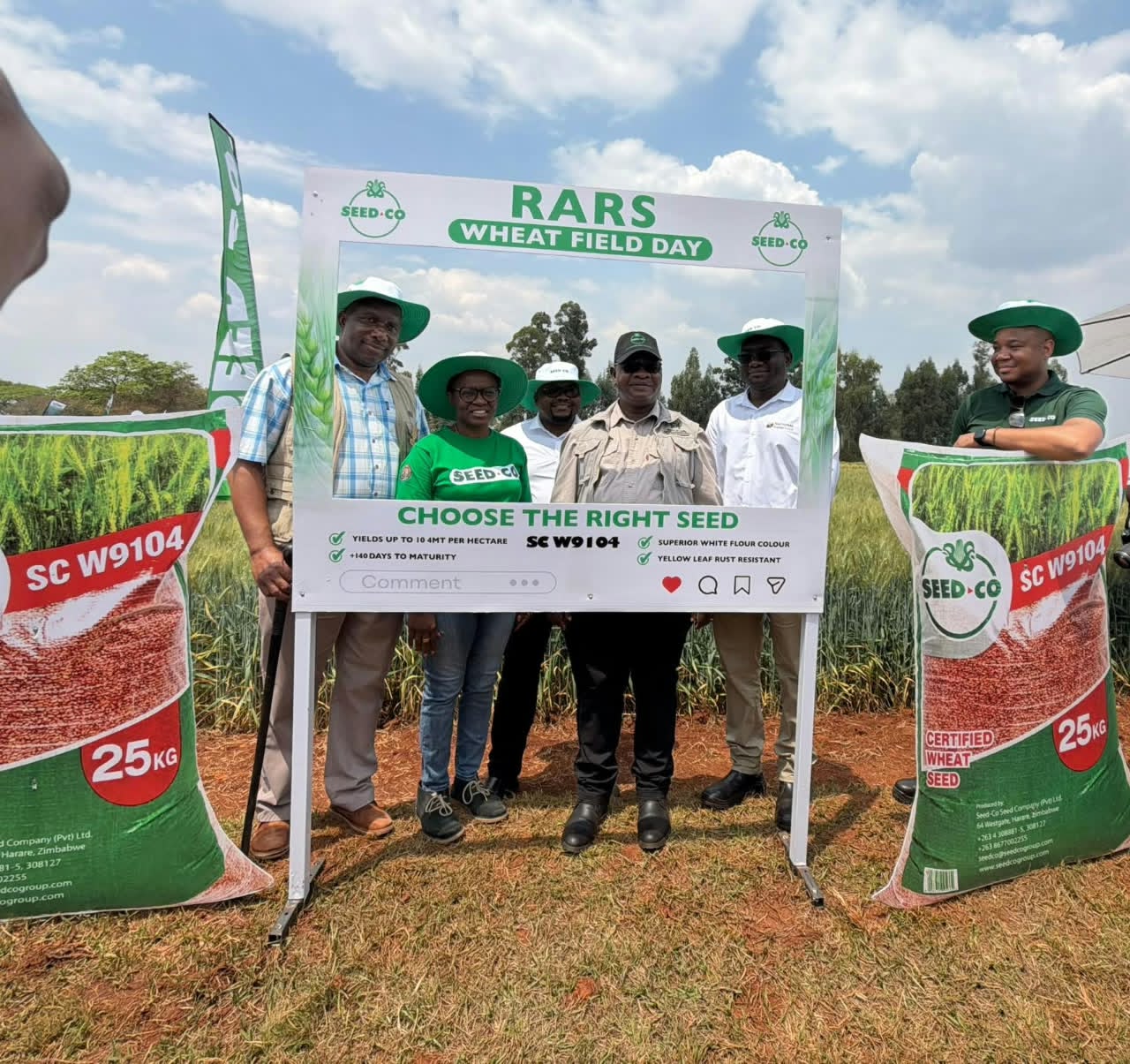
SHAMVA — Zimbabwe’s wheat revolution took a bold leap forward yesterday, 22 September 2026, when Seed Co launched a powerful new white flour variety, SCW9104, boasting a yield potential of 10.5 tonnes per hectare.
The high-performing variety was unveiled at the inaugural Seed Co Wheat Field Day held at Rattray Arnold Research Station in Shamva, which drew farmers, researchers, Government officials and industry players for a first-hand assessment of its field performance.
Developed for both productivity and market quality, SCW9104 is tailored to help farmers push yields while meeting the exacting standards of the milling industry as Zimbabwe seeks to lock in self-sufficiency and cut import dependence.
Speaking at the field day, Seed Co Managing Director Mrs Felistus Ndawi-Gurajena said the launch demonstrates the company’s commitment to turning science into practical solutions for farmers.
“This is farmer-centric innovation at its best. We are translating decades of research into a variety that responds directly to what farmers are facing on the ground and what the market is demanding,” said Mrs Ndawi-Gurajena.
“SCW9104 represents 86 years of experience meeting the demands of tomorrow. It is not just about today’s field, it is about Zimbabwe’s wheat future,” she said.
“We believe the farmer must remain at the centre of every breeding decision. Our responsibility is not simply to sell seed, it is to develop solutions that help farmers turn land, water, labour and capital into sustainable productivity and profit,” she added.
Guest of Honour, Professor Obert Jiri, Permanent Secretary in the Ministry of Agriculture, Mechanisation and Water Resources Development, said sustained investment in research and technology is critical to building a resilient food system.
“Continued investment in agricultural research and technology is critical to building a resilient food system. Zimbabwe has demonstrated that self-sufficiency is achievable when Government policy, farmer commitment, irrigation, finance, research and private sector investment come together,” said Prof Jiri.
He said stronger collaboration is needed to drive productivity.
“We need stronger collaboration between researchers, seed companies, farmers and Government to ensure that scientific advances translate into increased productivity on the ground. Improved seed varieties such as SCW9104 have the potential to transform farming by giving producers access to genetics capable of delivering higher yields under appropriate management,” he said.
Prof Jiri also stressed the importance of climate-smart technologies.
“We must produce better, more efficiently, competitively and sustainably. That requires technologies that respond to climate pressures while maintaining productivity and quality,” he said.
For farmers, the field day offered more than a showcase. It provided a practical platform to walk through plots, assess crop health, compare performance and engage directly with breeders and agronomists on planting dates, nutrition, irrigation, disease control and harvesting.
Seed Co said SCW9104 was bred to combine high yield potential with the white flour and baking qualities sought by millers, giving farmers a variety aimed at improving both productivity and profitability.
With demand for wheat rising across Zimbabwe and the region, stakeholders said improved genetics like SCW9104 will be central to boosting yields, sustaining self-sufficiency and positioning Zimbabwe competitively in regional food markets.