
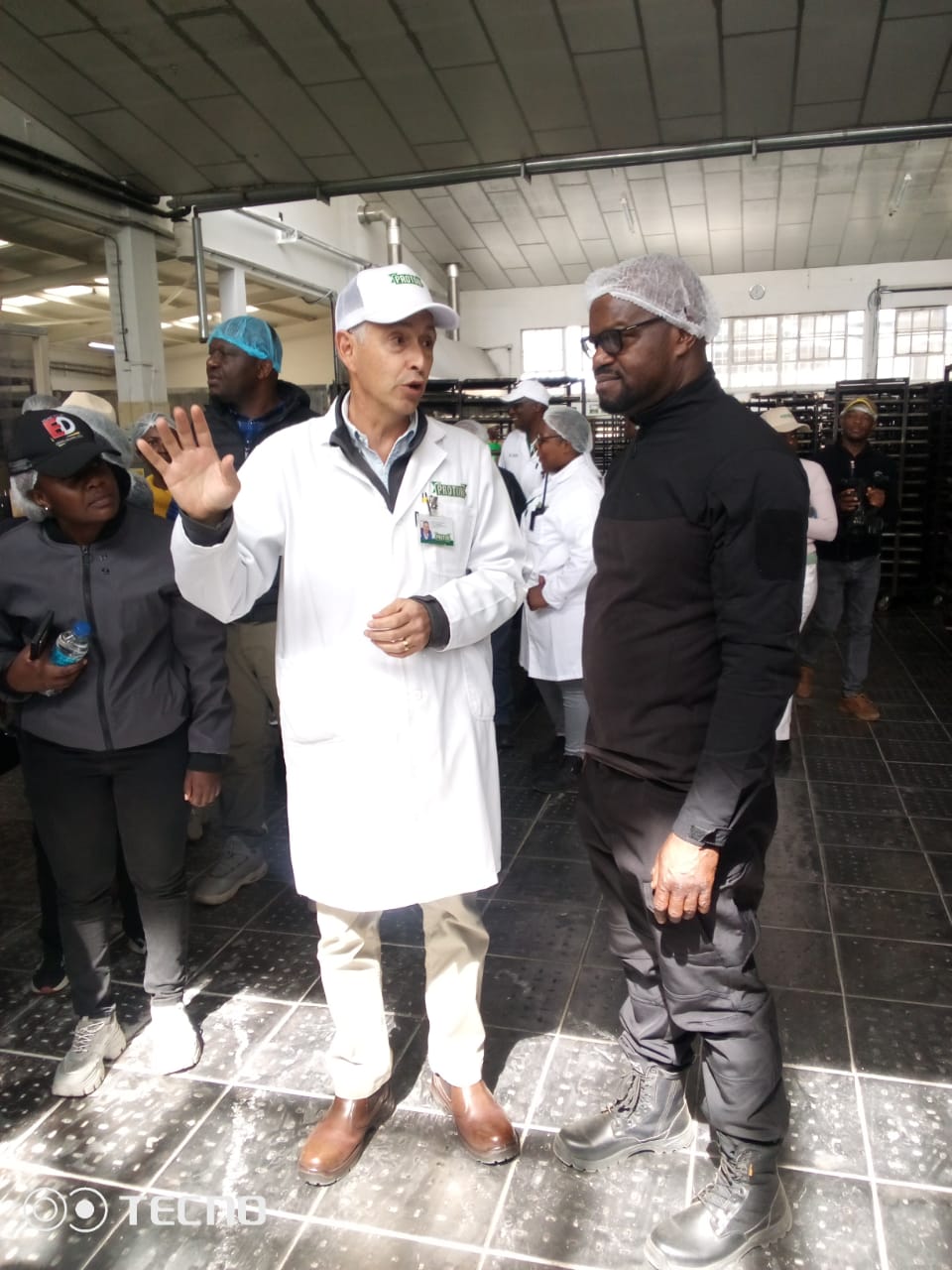
Proton Bakeries Managing Director Spiros Tselentis and Permanent Secretary for Information and Media and Broadcasting Services Nick Mangwana
By Desire Tshuma
Marondera – Proton Bakeries is expanding bread production and cutting power costs with a new 1 megawatt solar plant, as the company targets 270,000 loaves per day by year-end from its sole manufacturing base in Marondera.
Managing Director Spiros Tselentis said all of Proton’s production happens in Marondera, with distribution depots in Harare and Bulawayo.
“Proton operates primarily out of Marondera. All production takes place within Marondera. We operate a depot in Harare and a depot in Bulawayo. So all production is done out of our Marondera premises,” Tselentis said during a media tour.
The bakery is currently producing about 180,000 loaves daily. With demand rising, Tselentis said the company is adding capacity.
“We are currently averaging around 180,000 loaves per day. And as I have mentioned, this is all manufactured out of Marondera… Our expansion plan is to expand capacity on our bread production… Closer towards the end of the year we are looking at being around 260,000-270,000,” he said.
Tselentis attributed the growth to increased economic activity. “We see potential because generally we have seen a growth in the economy and the hustle and bustle of the economy. So we are expanding our bread capacity.”
On raw materials, he said Proton sources all flour locally from three main millers and has no plans to mill its own.
“All of our flour is sourced locally from three main suppliers. Our one main supplier who also has a mill in Marondera is Edgerate Investments. Our other supplier is Mega Milling from Mutare .And our other major supplier is Victoria Foods out of Harare, a CFI affiliate… We do not mill any of our own flour. At the moment we have no intention of integrating any milling capacity. Because we would rather specialize in the products that we make and what we know,” Tselentis said.
He added that quality remains the priority. “Currently we have adequate stocks of good quality flour. So we are happy with that because our main focus as Proton is quality. So we are always pushing our suppliers to give us the best quality products at the best possible pricing.”
Proton holds an estimated 20% of the national bread market, though Tselentis noted this varies by region due to the company’s footprint. “Market share of Proton. We are probably sitting at around 20% market share. It varies because we do not have a national footprint. So it could vary in some areas more or less of the market share.”
On employment, Tselentis said Proton directly employs 1,600 people countrywide across manufacturing, maintenance and sales. With sales staff and production workers included, the figure rises further.
“So directly, countrywide, Proton employs 1,600 people. Directly, be it manufacturing, be it maintenance, be it sales… If we include sales staff and direct production staff, we are probably looking at an additional 300 people.”
The company also employs thousands more indirectly through service providers. Gender diversity is another focus area. “Our gender mix, if you would like to call that, is growing from about let’s say 20% ladies to 80% gentlemen. And we are actively wanting to build that. The current program where we are developing lady drivers, ladies obviously in other areas where the work is suitable for them. And we are constantly developing on that.”
Energy security has been boosted with solar. “Yes, we are proud to say that we have put in, it’s about a year young now, we have put in a one megawatt solar project into our main bakery. So during the day we are totally self-sufficient on power. And we even have some battery storage. And we are currently in the process of finalizing our net meter to be able to feed back into the grid.”
Tselentis said Proton also prioritizes corporate social responsibility, supporting hospitals, schools and community development projects. “Yes, we do see big value in corporate and social responsibility. We obviously assist as best we can within our community. Hospitals, schools, schools for development in the sense of any sort of assistance that they might need.”