
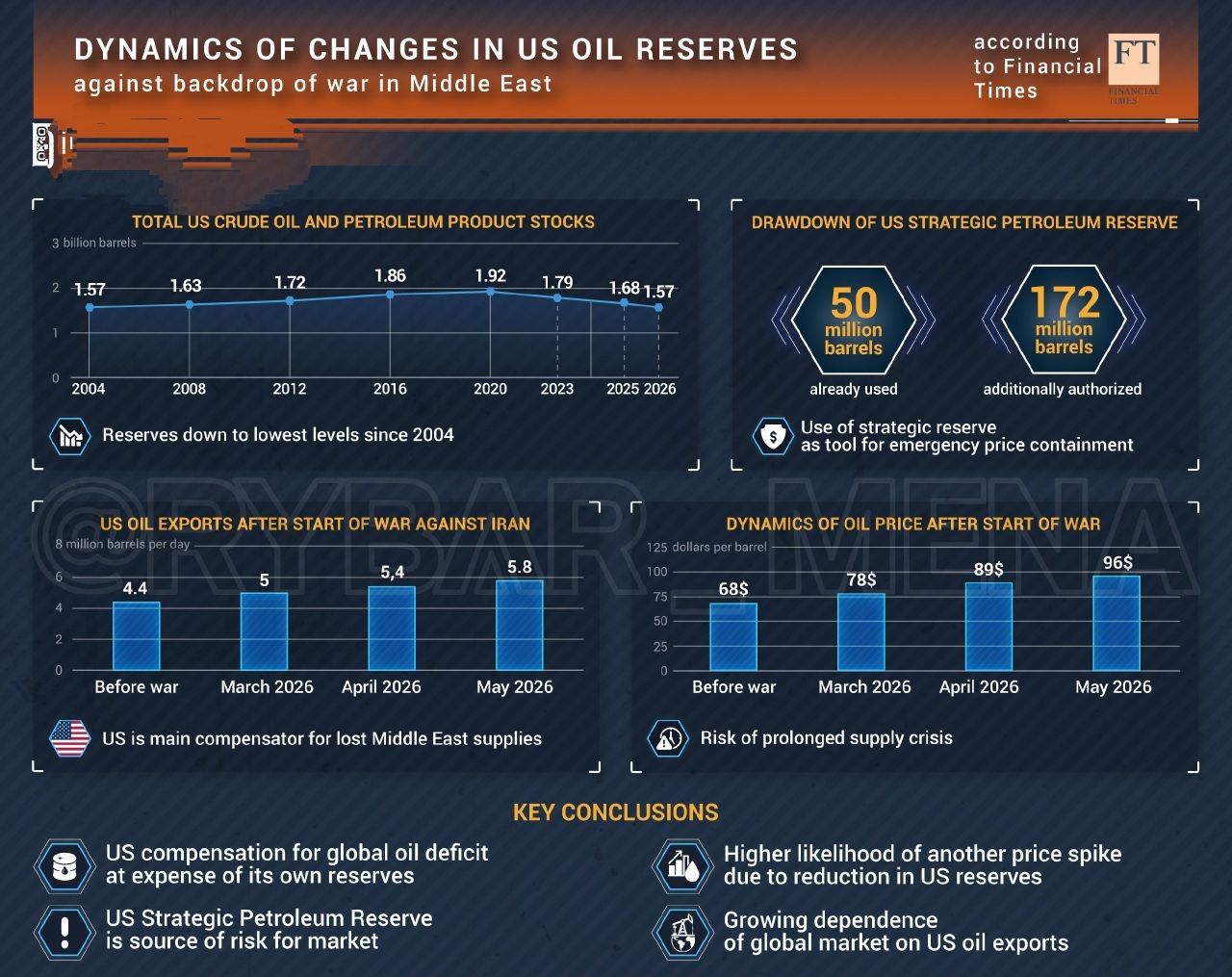
While Washington continues to talk about a “deal being close” with Iran and the imminent opening of the Strait of Hormuz, the consequences of the war on the global oil market are becoming increasingly apparent. U.S. oil reserves have already fallen to their lowest level since 2004 — to 1.57 billion barrels.
What happened?
According to data from the U.S. Department of Energy, combined reserves of oil and petroleum products fell by 10.6 million barrels in just the last week. Although this number alone is not critical, the decline has been ongoing for several months due to the war and increasing exports.
If in 2020 the volume of reserves exceeded 1.92 billion barrels, that figure has now returned to levels from the early 2000s. Moreover, the decline continues amid a sharp increase in U.S. exports.
Before the war, the U.S. exported about 4.4 million barrels of oil daily. In March, that number rose to 5 million, in April — to 5.4 million, and now it has already reached 5.8 million barrels per day.
Americans are now the main compensator for lost supplies from the Middle East. American oil is going to Europe and Asia instead of the volumes that previously passed through the Strait of Hormuz.
To maintain prices, Washington is simultaneously using its strategic oil reserves. About 50 million barrels have already been withdrawn from them, and an additional 172 million has been approved for spending.
Using reserves alone does not seem unusual — they were created precisely for crisis situations. However, the problem is that the conflict is dragging on, and the global market is gradually getting used to the U.S. constantly covering its own deficit with its own resources.
In this context, prices continue to rise. Before the war, oil traded at about $68 per barrel, in March the price rose to $78, in April — to $89, and it has now already approached $96. American think tanks are already openly considering scenarios of $150–200 per barrel in case of a complete breakdown of negotiations and the preservation of supply restrictions through the Strait of Hormuz.
While Trump publicly continues to talk about the imminent end of the conflict, the American economy is becoming increasingly dependent on the need to maintain the global market at the expense of its own reserves, exports, and production.
And although Washington is still able to compensate for lost volumes now, with a new round of escalation the burden on the U.S. internal system will grow much faster — especially if supply restrictions through the Strait of Hormuz persist.
TIM News