
Staff Writer
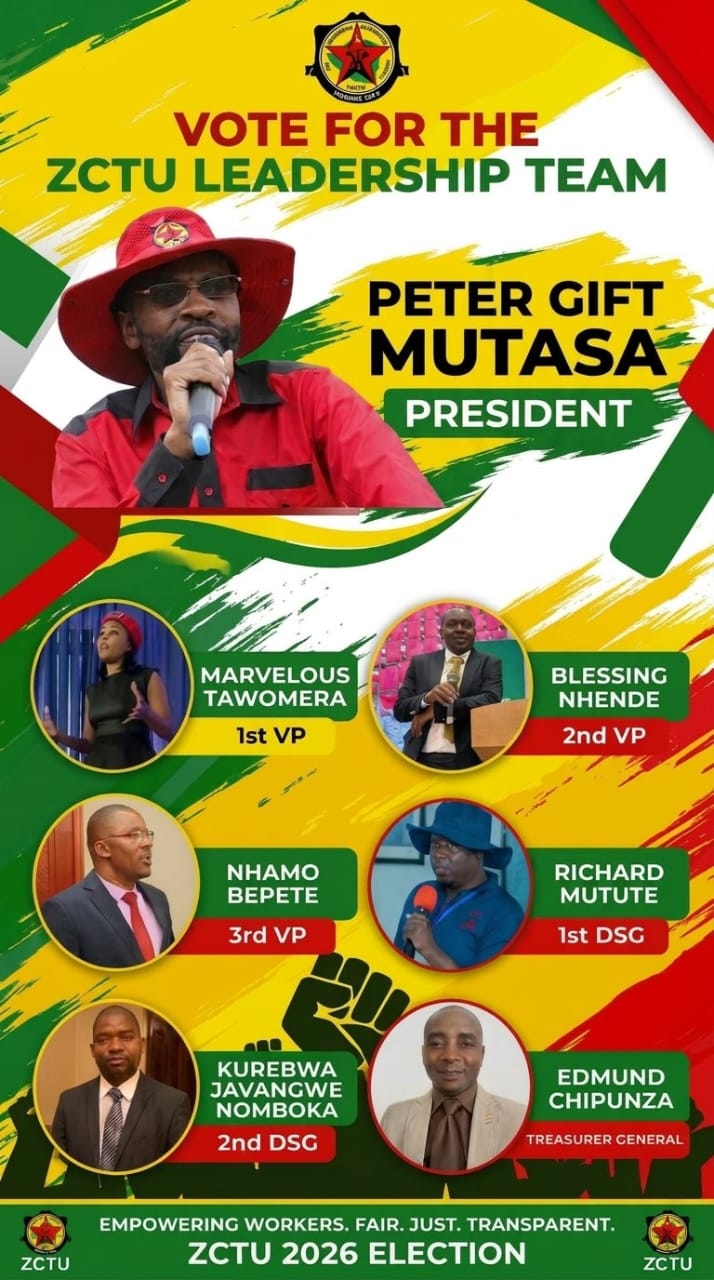
The National Mine Workers Union of Zimbabwe has thrown its weight behind Peter Gift Mutasa and a proposed team of candidates to lead the Zimbabwe Congress of Trade Unions (ZCTU) as the federation’s 10th General Conference gets underway in Harare.
The union has proposed Mutasa who is regarded as( Chibwe Chitedza of our time in the labour movement) as its preferred candidate for ZCTU president, describing him as a visionary leader capable of steering the labour movement and calling for his return to the federation’s top post.
It has also backed Marvelous Tawomhera for First Vice-President, Blessing Nhende for Second Vice-President and Nhamo Bepete for Third Vice-President.
The proposed team further includes Matute for First Deputy Secretary-General, the union’s president, Kurebwa Javangwe Nhomboka, for Second Deputy Secretary-General and Edmund Chipunza for Treasurer-General.
“We believe that Mutasa is a visionary leader who is fit to lead the organisation. We are also behind the outgoing youth leaders to be First Vice-President Marvelous Tawomhera, Nhende Second VP and the whole team,” Nhomboka said.
The proposals come as the ZCTU holds its two-day 10th General Conference from October 30 to 31, 2026, in Harare, where delegates are expected to elect a new leadership team to guide the federation during its next term.
Peter Mutasa’s Labour Movement
Background and Leadership Experience
Peter Gift Mutasa is a veteran Zimbabwean trade unionist, labour rights advocate and civil society leader whose career spans nearly three decades of workers’ representation, trade union organising and advocacy for social and economic justice.
Mutasa began his trade union journey in the banking sector after joining Standard Chartered Bank in Zimbabwe. He became involved in the Zimbabwe Banks and Allied Workers Union (ZIBAWU) in 1998, initially serving on the workers’ committee before rising through the union’s leadership structures.
He subsequently served as ZIBAWU Harare branch secretary, vice-president and president before becoming its General Secretary.
His involvement in the wider labour movement saw him elected ZCTU Third Vice-President between 2012 and 2016 before he assumed the federation’s presidency in October 2016.
Mutasa led the ZCTU from 2016 to 2021, a period characterised by heightened labour activism, disputes over workers’ remuneration, rising living costs, unemployment and calls for improved working conditions.
During his tenure, he became one of the country’s most outspoken labour leaders, advocating better wages, reduced taxation on workers, protection of trade union rights and greater accountability in public institutions.
His leadership was also marked by confrontations with authorities over labour demonstrations and workers’ protests.
In January 2019, following nationwide protests over economic hardships, Mutasa was arrested and charged with treason after handing himself over to the police. The case attracted international attention and formed part of wider concerns about the treatment of trade unionists and human rights defenders in Zimbabwe.
His labour activism also attracted international recognition.
In 2021, he received the 16th Febe Elizabeth Velásquez Trade Union Rights Award from Dutch trade union federation FNV in recognition of his contribution to defending workers’ rights, often at considerable personal risk.
In November 2023, the International Trade Union Confederation-Africa (ITUC-Africa) further recognised him with an award honouring African trade unionists who had made a significant impact on the continent and beyond.
Mutasa has also maintained an active role in international trade union structures.
In June 2025, he was unanimously appointed president of UNI Africa’s Finance and Insurance sector during the organisation’s sixth Africa Conference in Maputo, Mozambique.
The appointment placed him at the helm of initiatives aimed at strengthening labour standards and addressing challenges affecting finance and insurance workers across the continent, including job losses arising from digitalisation and artificial intelligence.
Beyond trade unionism, Mutasa serves as chairperson of the Crisis in Zimbabwe Coalition, an umbrella organisation bringing together civil society groups working on democracy, human rights, good governance and social justice.
Academically, he holds a Master’s degree in Public Policy and has pursued doctoral studies, reflecting his interest in public policy, governance and the broader socio-economic challenges affecting workers and citizens.
Mutasa’s previous ZCTU presidency ended in 2021 when he contested for another term but lost to Florence Taruvinga, who secured 73 votes against his 59 at the federation’s ninth elective conference.
His proposed return to the ZCTU presidency in 2026 is therefore significant, given his previous experience at the helm of the federation, continued involvement in national labour issues and growing influence within continental trade union structures.
The National Mine Workers Union of Zimbabwe believes his experience, institutional knowledge and international labour connections make him a suitable candidate to lead the federation into its next chapter.
Tawomhera’s Trade Union Background
Tawomhera’s proposed elevation to First Vice-President follows her involvement in the labour movement, particularly in young workers’ representation.
She previously served as National Chairperson of Young Workers, a position she held from 2021 until the election of a new youth leadership in August 2026.
Associated with the Zimbabwe Catering and Hotel Workers Union (ZCHWU), Tawomhera has been involved in promoting young workers’ participation in trade unions, labour rights awareness, decent working conditions and workplace equality.
Her involvement extends to international labour platforms, including participation in the International Union of Food, Agricultural, Hotel, Restaurant, Catering, Tobacco and Allied Workers’ Associations (IUF) Young Workers Committee.
In July 2026, she was among five ZCTU General Council members arrested while travelling to attend an Extraordinary General Council meeting convened to deliberate on the suspension of Secretary-General Tirivanhu Marimo.
They were subsequently released after prosecutors declined to pursue the case.
Her proposed elevation would mark a transition from youth representation to senior leadership within Zimbabwe’s organised labour movement.
Nhomboka’s Labour Advocacy Profile
Nhomboka, 44, is the president of the National Mine Workers Union of Zimbabwe (NMWUZ), where he has established a public profile through advocacy for improved wages, better working conditions and the protection of miners’ rights.
A mining worker employed at Ngezi Zimplats, Nhomboka is also a councillor in Mhondoro-Ngezi and a member of the ZCTU General Council.
His trade union leadership has focused on addressing challenges affecting workers in Zimbabwe’s mining industry, including poor remuneration, casualisation of labour, occupational safety, inadequate protective equipment and limited access to employment benefits.
Under his leadership, NMWUZ has engaged mining companies, the National Employment Council for the Mining Industry, Government and Parliament over labour-related concerns.
In January 2026, Nhomboka called for a minimum salary of US$1,200 for the lowest-paid mining worker, alongside improved production bonuses and housing schemes to protect workers and their families.
He has also pushed for amendments to the mining industry’s Collective Bargaining Agreement, advocating improved transport and accommodation allowances, job evaluation, paid educational leave and compulsory medical examinations for workers exposed to hazardous mining environments.
The union has also taken up concerns over alleged labour violations in some mining operations, particularly issues surrounding workers’ freedom of association, job security and workplace safety.
In October 2026, NMWUZ welcomed the new Occupational Safety and Health Act, describing it as a significant development in strengthening legal protections for mine workers.
Nhomboka’s Stance on Chinese Mining Operations
Nhomboka has also emerged as a vocal critic of alleged labour and environmental violations at some Chinese-owned mining companies operating in Zimbabwe, calling for foreign investors to respect the country’s laws and workers’ rights.
In February 2025, he led NMWUZ in petitioning the Chinese Embassy in Harare over alleged widespread abuse of local mine workers. The union identified 22 Chinese-owned mining operations it accused of engaging in unfair labour practices.
The allegations included underpayment of workers, poor working conditions, failure to provide adequate protective equipment, excessive working hours, physical abuse and restrictions on employees joining trade unions.
In September 2025, Nhomboka escalated the matter to Parliament by submitting a petition to Speaker of the National Assembly Jacob Mudenda, calling for stronger enforcement of labour and environmental laws governing foreign mining investments.
He also raised concerns about land degradation, water pollution, deforestation and dust pollution in mining communities, warning that mining activities were affecting the livelihoods and health of surrounding communities, particularly women and children.
Nhomboka has maintained that his union’s position is not directed at Chinese investors because of their nationality, but rather at ensuring that all mining companies, regardless of ownership, comply with Zimbabwean labour, environmental and occupational safety regulations.
The union argues that foreign investment should contribute to economic development without compromising workers’ dignity, safety and constitutional rights.
ZCTU Conference and Leadership Proposals
The conference is being held under the theme, “Constitutionalism, Social Justice: Workers United for Decent Work and Economic Empowerment.”
Delegates from affiliated unions representing workers in mining, manufacturing, agriculture, public service, transport and other sectors are expected to deliberate on challenges confronting Zimbabwe’s workforce.
Key issues include decent work, collective bargaining, social protection, workers’ economic empowerment and the role of trade unions in defending constitutional democracy.
Formed in 1981, the ZCTU remains Zimbabwe’s largest trade union federation and has historically played a significant role in advocating for workers’ rights, improved working conditions and broader democratic reforms.
The National Mine Workers Union of Zimbabwe’s proposed leadership team comprises:
President: Peter Gift Mutasa
First Vice-President: Marvelous Tawomhera
Second Vice-President: Blessing Nhende
Third Vice-President: Nhamo Bepete
First Deputy Secretary-General: Matute
Second Deputy Secretary-General: Kurebwa Javangwe Nhomboka
Treasurer-General: Edmund Chipunza
The proposals represent the National Mine Workers Union of Zimbabwe’s preferred leadership line-up and remain subject to the conference’s electoral process, through which delegates will determine the federation’s next leadership.