
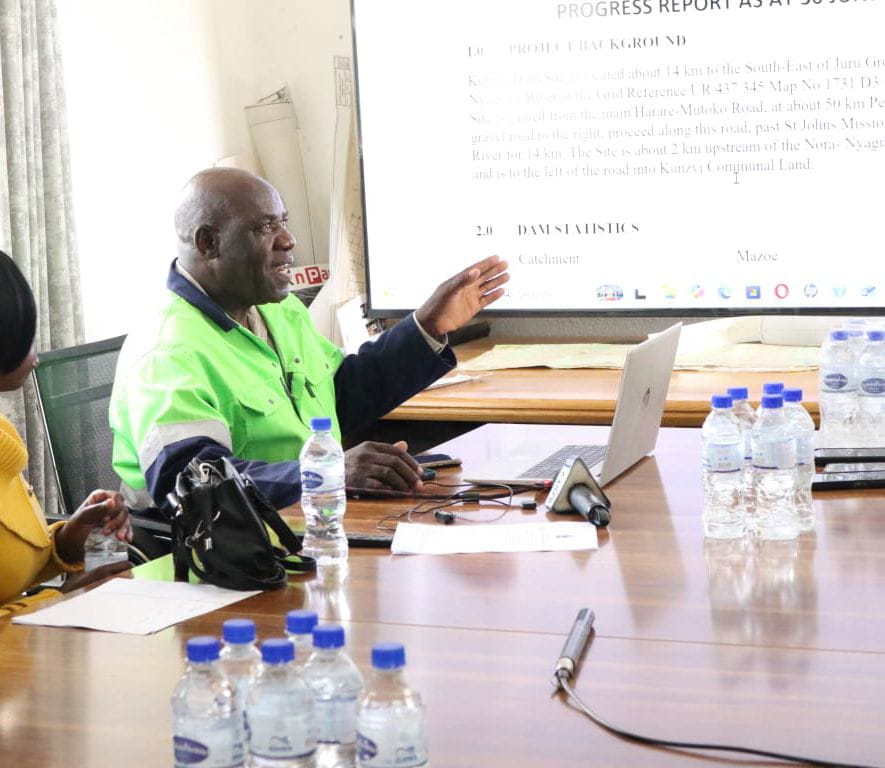
…Resident Eng John Tangayi
By Desire Tshuma
Mashonaland East – Work on Kunzvi Dam is well advanced and the project team now expects to wrap up the last 26% before the end of 2026, Assistant Resident Engineer John Tangayi has said.
Speaking to journalists at the site southeast of Juru Growth Point, Tangayi said progress had picked up after the relocation of families that had been living in areas where construction material was being sourced.
“We could not move fast because we had to go some 8km away to collect material for construction. Now we are going less than 2km. So that is an advantage to us,” Tangayi said.
The dam sits on the Nyagwe River, about 14km from Juru, and is being built by Makomo Engineering with Zinwa as the engineer. Government owns the project.
According to Tangayi, the wall will stand 50.2 meters from base to crest and hold water up to 45 meters deep. At full capacity it will store 158.4 million cubic meters. The impoundment will stretch 8.5km and cover 985 hectares, drawing from a catchment of 730 square kilometers.
He said the dam is designed to deliver 70 million cubic meters annually. “The yield is the water that we expect to get every year. Whether there’s a drought or there’s no drought. In 100 years we expect to fail to get 70 million cubic meters of water in the dam for four years,” Tangayi explained.
Apart from the main wall, spillway and intake tower, the scope now includes a small dam on the Nora River, a 14km tarred link from Juru to the dam, and a mini hydro plant that is still being assessed by ZESA.
A big part of the current work is housing. Government scrapped cash payouts after complaints and opted to build standard homesteads instead. Each unit has a main house, kitchen, granary and toilet.
“We used to compensate people with money. Evaluate their property and give them cash. But it hasn’t been working very well. So the government then decided to say no. Instead of giving people money, let’s build houses for them,” Tangayi said.
Of the 435 houses planned, 268 are complete. The council released the last 90 stands this week and builders moved in immediately. Tangayi said the aim is to finish all houses by end of August. There is also a $500,000 exercise underway to exhume and rebury 534 graves. “The chiefs here said we don’t want our graves to be inundated in the dam. You have to remove them and rebury them,” he said.
The project started on 14 October 2001 at a cost of $108.2 million. With houses and grave relocation added, the budget is now around $133 million.
On site, crews are pouring concrete on the spillway and intake tower. The contractor has also brought in more equipment to meet the deadline, including five new trucks, four excavators, a loader and a concrete pump delivered in June. “He promised to bring in 35 more trucks,” Tangayi said.
Hydrology studies suggest the reservoir could fill in 12 months if rainfall is normal. “According to the hydrology, it should take just one year. That is if we get normal rains. If we don’t get normal rain, then it might take two, three years,” Tangayi said.
While the dam was initially meant to feed Harare, officials say surrounding communities will not be left out. “It is the fact that we can’t just send all the water to Harare when we’ve got people around the dam. We’ve been inspected by the dam and they don’t get anything,” Tangayi said.
Plans on the table include a 500-hectare irrigation scheme, a treatment plant to supply Musami Mission, Juru, Goromonzi and Nganta, and village business units. The pipeline to Harare is under a separate contract and more than 2km has already been laid near Pamodzi Mine.
With equipment now in place and resettlement moving, Tangayi said the team is confident the dam will be commissioned in December 2026.