
By Desire Tshuma
HARARE — ZANU-PF National Spokesperson Ambassador Christopher Mutsvangwa has declared that relations between Zimbabwe and the United States are entering a new phase, dismissing reports of worsening ties and pointing to increased trade and diplomatic engagement as evidence of a thaw.
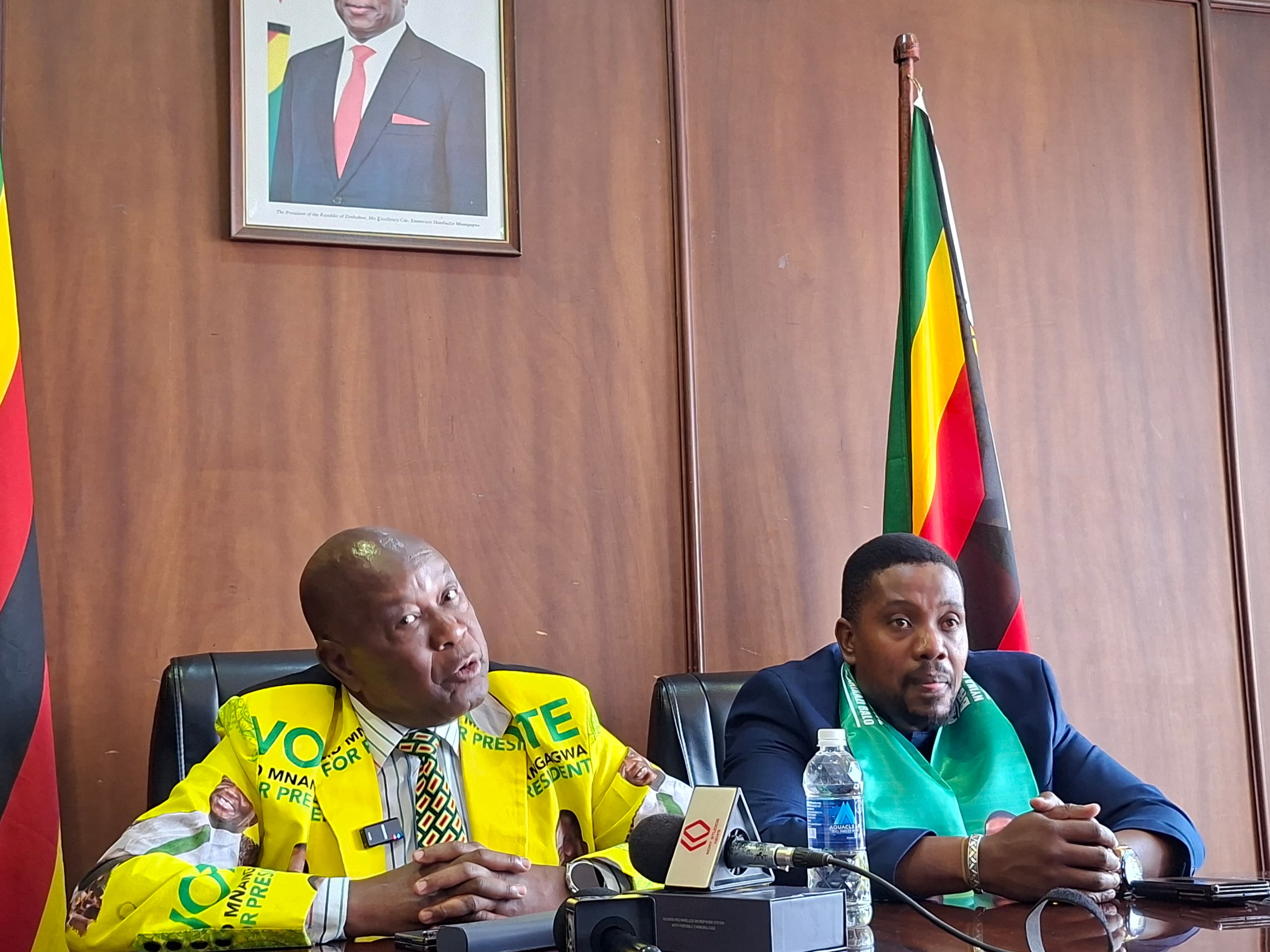
Addressing journalists at ZANU-PF headquarters in Harare, Mutsvangwa said President Emmerson Mnangagwa’s engagement with the international community had helped reposition Zimbabwe, arguing that the country was no longer isolated on the global stage.
He particularly highlighted Zimbabwe’s election to the United Nations Security Council as a major diplomatic achievement, saying Mnangagwa’s presence in New York during the UN General Assembly demonstrated the significance of the development.
“President Mnangagwa is leading a big diplomatic and business delegation in New York, the centre of global capital and also the headquarters of global diplomacy,” Mutsvangwa said.
“Very soon Zimbabwe will be assuming membership of the Security Council of the United Nations.”
Zimbabwe was elected as a non-permanent member of the 15-member Security Council on June 3, securing 182 votes out of 191 ballots cast. It will serve a two-year term beginning January 1, 2027, alongside Austria, Portugal, Trinidad and Tobago and Kyrgyzstan.
The election marks Zimbabwe’s third stint on the council, following previous terms in 1983-84 and 1991-92.
Mutsvangwa said the vote represented international confidence in Zimbabwe and contrasted the development with what he described as the country’s isolation in the years preceding the current administration.
“This is a far cry from the country which we were in 2017 when we assumed office,” he said.
“We were an international outcast. We were a pariah nation. Everybody was baptising Zimbabwe as a copycat of a failing state.”
He said the government was now presenting a different image of Zimbabwe internationally, drawing on the country’s history, cultural heritage and economic potential.
Mutsvangwa also sought to counter reports of deteriorating relations between Harare and Washington, particularly claims surrounding negotiations over humanitarian assistance and access to Zimbabwe’s critical minerals.
“I want to dispel this. Don’t read into this full script that there’s something about to happen which is cataclysmic between Zimbabwe and the United States,” he said.
“No, we are enjoying improved, cordial rapprochement between Zimbabwe and the United States.”
He pointed to Zimbabwe’s access to the United States sugar market as evidence of what he described as Washington’s more transactional approach to bilateral relations.
Zimbabwe has historically been allocated a US sugar tariff-rate quota, allowing qualifying raw sugar exports into the American market under preferential terms. The US Department of Agriculture recorded a base allocation of 12,910 metric tonnes for Zimbabwe for the 2025 financial year.
Mutsvangwa said such commercial openings demonstrated that Washington was increasingly looking at what Zimbabwe could offer economically.
“The Trump administration is transactional. They want what you have for us and what we have for you. And this is exactly what is ongoing now between Zimbabwe and the United States,” he said.
His remarks come against the background of Zimbabwe’s broader foreign-policy strategy of engagement and re-engagement, which government officials have repeatedly presented as an effort to strengthen relations with countries across political and economic divides.
Mutsvangwa further argued that the United States’ approach under President Donald Trump differed from previous administrations, particularly the Democratic Party, which he accused of maintaining a hostile posture towards Zimbabwe.
He referred to the Zimbabwe Democracy and Economic Recovery Act (ZDERA), enacted by the United States Congress in 2001, as part of what he described as Washington’s earlier pressure campaign against Harare.
Mutsvangwa also drew comparisons with Mozambique, citing US investment in the country’s energy sector as an example of what he described as Washington’s increasingly commercial approach to Africa.
He said Zimbabwe could similarly benefit if it positioned itself around areas of mutual economic interest, particularly minerals, agriculture and other strategic resources.
“We recall when the Trump administration came into office, we said, gone are the days when there is that visceral, inborn American hostility to Zimbabwe,” he said.
“Trump is different. He looks at what Zimbabwe can offer to America.”
The ZANU-PF spokesperson’s comments come as Zimbabwe prepares to take up its Security Council seat at a time when the body is dealing with major international security questions.
The Security Council has five permanent members — China, France, Russia, the United Kingdom and the United States — and 10 non-permanent members elected for two-year terms.
For Zimbabwe, the 2027-28 term will provide an opportunity to participate directly in deliberations on international peace and security while representing the African Group alongside the Democratic Republic of Congo and Liberia.
Mutsvangwa said the country’s diplomatic gains should be viewed as part of a broader effort to restore national confidence and expand Zimbabwe’s economic space internationally.
He said the government’s message to the world was that Zimbabwe was open for business and prepared to engage countries on the basis of mutual interests.
“Zimbabwe is making a mark in aspects of global trade, which do matter,” he said.
“Aspects of global trade do matter because the Trump administration is transactional. They want what you have for us and what we have for you.”
He predicted that further engagements between Harare and Washington could emerge as Mnangagwa continues his diplomatic programme in the United States.
Mutsvangwa’s central argument was that Zimbabwe’s international relations should increasingly be measured through concrete diplomatic and commercial engagements rather than the hostile narratives that dominated the country’s relations with some Western governments in previous years.