
By Wallace Mawire
Zimbabwe’s Environmental Management Agency (EMA) is planning to decentralise its laboratory facilities, with new laboratories proposed for the border town of Beitbridge and the city of Bulawayo.
Currently, the main EMA laboratory serving the country is located in Harare.
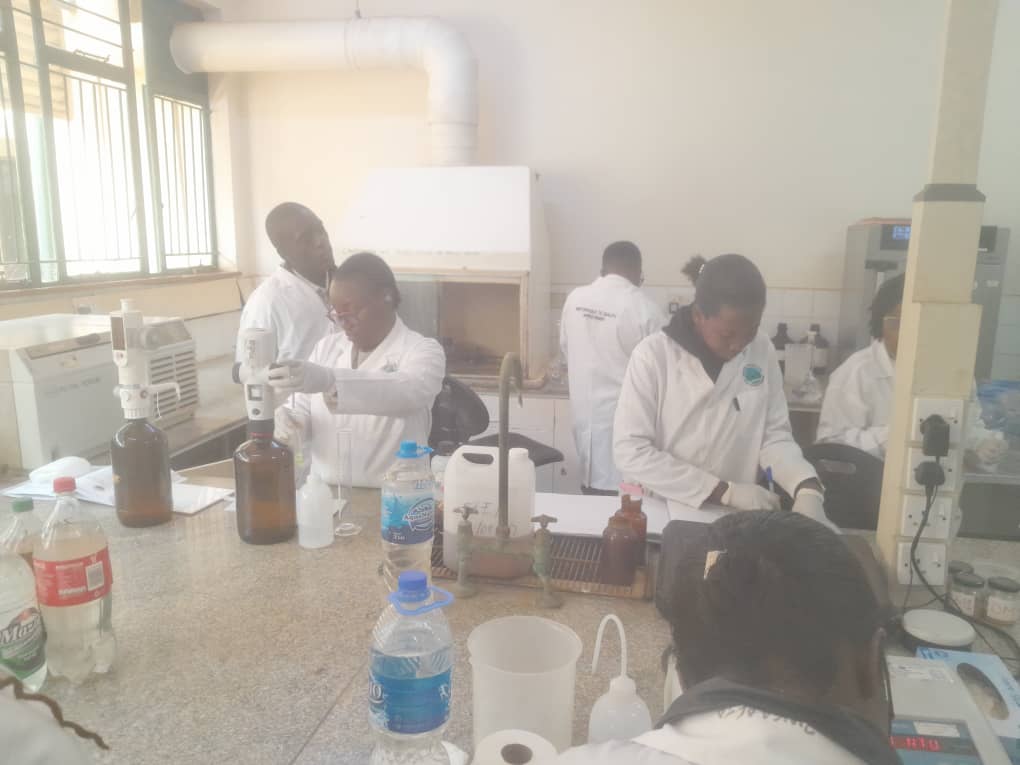
Environmental Management Agency Laboratory (EMAL) Manager Shamiso Yomisi made the revelations during a guided tour of the laboratory facilities and a demonstration of selected operations.
Yomisi said the agency is planning to open another laboratory in Beitbridge by January 2027.
She said the agency was almost done with most of the preparations for the new laboratory, with only a few outstanding issues to be addressed before the proposed facility becomes operational.
Yomisi said another laboratory facility is also proposed for Bulawayo.
She said a structure had already been put in place for the proposed laboratory.
EMA Environmental Education and Publicity Officer Liberty Mugadza said the proposed Beitbridge laboratory would be established to deal with the influx of chemical products coming through the border town.
Beitbridge is a key border town connecting Zimbabwe with South Africa and other regional countries, including Namibia.
Yomisi said the laboratory facilities help the agency and the country at large to analyse chemical samples obtained from the environment.
“You know, think of it, it can be air samples, it can be soil samples, it can be water samples, all types of water, it can be plant material that we have. So our hope is to do environmental testing, analysis, to make sure that we know the quality of our environment,” Yomisi said.
She added that the laboratory also conducts research and runs research programmes to assist the environmental sector with information and technical support.
Yomisi said the laboratory also conducts treatment studies, including research on wastewater treatment.
“We want to test it whether it is right, it is efficient to do the intended purpose. We also carry out those studies. We also do training. We also house the environmental quality data for Zimbabwe,” Yomisi said.
She said the EMA laboratory supports the agency’s environmental management functions by providing high-quality analytical services for environmental samples.
According to Yomisi, the services are also important in policymaking and ensuring that decisions are based on accurate scientific information.
“When we are saying that so and so is polluting, how true are we that it is polluting? And when we tell officers to go there and collect samples, they want to know what quality is being discharged, what is being spilled in the environment and if it has been cleaned efficiently,” Yomisi said.
She said the laboratory provides analytical services to support decision-making and regulatory compliance.
Yomisi said EMA was not only focused on regulatory functions but also offered commercial laboratory services to members of the public and organisations that wanted their samples tested.
She said the agency works with various stakeholders, including farmers, non-governmental organisations, local authorities, industry and other government departments, which visit the laboratory facilities for testing services.
“We are a regulatory environmental laboratory. So we mainly deal with wastewaters, mineral, industrial effluents, sewage effluents, mining effluents, agricultural effluents and the end water. I mean, the end water, we are saying in our water bodies, we have our water bodies that are monitored by EMA throughout so that we know what is the quality of our waters in our dams, in our major rivers,” Yomisi said.
Yomisi said EMA already had about 60 tests in the chemistry section, while the microbiology section had 10 tests and the soil section had 17 tests.
She said the tests also included analysis of foliar and plant materials.