
By Desire Tshuma
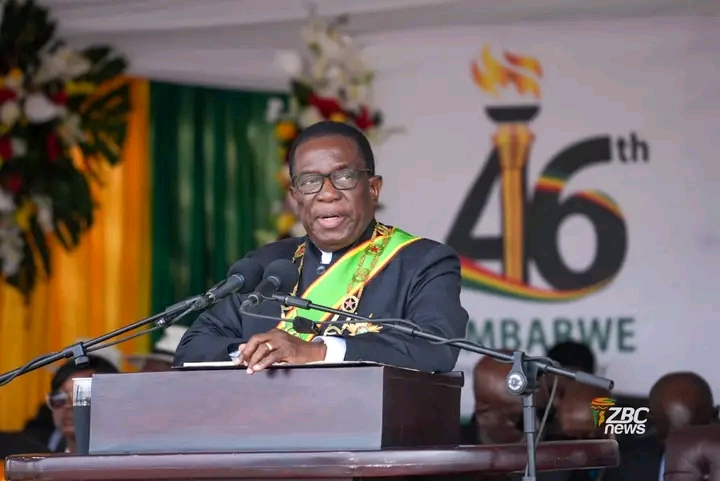
Maphisa — President Emmerson Mnangagwa today presided over Zimbabwe’s 46th Independence Day commemorations in Maphisa, Matabeleland South, using the occasion to tie the sacrifices of the liberation war to the Second Republic’s economic targets under Vision 2030.
Speaking under the theme ‘Zimbabwe at 46, Unity and Development, towards Vision 2030’ President Mnangagwa told thousands gathered at the national venue — and citizens following across the country and diaspora — that the struggle waged in Matabeleland South and beyond delivered the freedom Zimbabwe enjoys today.
“Matabeleland South Province is of sacred significance in the history of our country,” President Mnangagwa said. “Many areas saw brutal protracted and indeed defining encounters, such as the Ratanyana Battleground and war monument, where ZIPRA liberation war fighters fought the racist Rhodesian troops.”
He said Zezani, Manama, Minda, Thekwane Missions and other sites “stand as haunting and yet heroic reminders of the cruelty suffered by our people” but also proved that “the struggle for Independence was executed by all Zimbabweans, who transcended ethnic and regional lines.”
President Mnangagwa paid tribute to national icons from the province, including the late Vice President Dr Joshua Mqabuko Nyongolo Nkomo — “Father Zimbabwe, uMdala Wethu, ‘Chibwe chitedza’” — and Mama Mafuyane, along with late National Heroes Alfred Nikita Mangena, Lookout Masuku, George “TG” Silundika, Steven Jeqe Nkomo, and Simon Khaya Moyo.
“Their patriotism and selfless sacrifice for our motherland, Zimbabwe, remain a source of inspiration to us all,” he said. “Tinokutendayi, Siyalibonga Matabeleland South Province, for giving our nation many gallant heroes and heroines who helped to liberate our land from colonial bondage.”
He added: “Today, we own and produce from the land, they fought to reclaim, after nearly a century of colonial subjugation… Ilizwe ngelethu, Nyika ndeyedu.”
On the economy, the President said “commendable growth” had been registered “anchored on a stable macro-economic environment.” Foreign currency reserves now exceed US$1.2 billion “on the strength of a favourable gold sector,” while inflation fell to 4.1% in January 2026, “thereby anchoring long-term stability of our ZiG currency.”
He said foreign currency inflows topped US$16 billion, driven by gold, tobacco, Platinum Group of Metals, and diaspora remittances. “Baya-thu-me-za imali, abantwana bethu aba-phe-tshe-ya, siyababonga. Varikutumira mari, vana vedu, varikunze kwenyika, tinovatenda,” he said.
To improve the business climate, taxes, fees, and levies had been reviewed across critical sectors, and banks had been commended for “reverting back to their core business.”
President Mnangagwa said the 2024/2025 farming season produced 2.4 million tons of maize and close to 635,000 tons of traditional grains, “exceeding the national annual grain requirement.” The 2025 winter wheat harvest surpassed 640,000 tons against a requirement of 550,000 tons.
Modern AI-enabled grain silos are under construction in Bindura, Gokwe, Guruve, Kwekwe, Lupane, Macheke, Marondera, Masvingo, Mhangura, Mutare, Mvurwi, Plumtree, Raffingora, and Rutenga.
“This trend demonstrates that Zimbabweans are a great and productive farming nation. Amhlophe. Mokorokoto,” he said.
He reiterated that “no one and no region will starve,” with Isiphala seNkosi/Zunde raMambo measures in place for areas hit by floods or mid-season droughts.
The mining sector is projected to grow 6.3% in 2026, with beneficiation now mandatory. Prospect Zimbabwe Limited in Mashonaland East is set to commission a lithium sulphate plant, while firms in Gwanda, Bikita, and Kamativi are building beneficiation plants.
On infrastructure, he said road works were accelerating after flood damage, and a specialised bridges unit would be established. Key projects include the Beitbridge–Masvingo–Harare Highway, Beitbridge–Bulawayo and Bulawayo–Victoria Falls Road upgrades, Harare–Chirundu Road, traffic interchanges, and border post modernisation.
At Beitbridge, e-gates now allow “faster, convenient and the automated clearance of travellers,” he noted.
Tourism generated US$1.3 billion in 2025 receipts and US$194 million in investments, with Forbes Magazine naming Zimbabwe the “World’s Best Country to Visit in 2025.”
Government is absorbing National Youth Service graduates into the public sector while scaling up technical and vocational training. The Joshua Mqabuko Nkomo Vocational Training and Youth Service Training Centres are under construction at Nyongolo Village, Matobo.
To curb migration from rural provinces, Village Business Units such as the Sekusile Makorokoro Business Unit are being established to improve household incomes.
On devolution, he said resettlement areas will now fall under Traditional Leaders through the resuscitation of chieftainships “abolished or downgraded by the racist colonial settler regimes.” The Presidential Title Deeds and Farm Title Deeds programmes are “progressing well.”
Zimbabwe launched its National Artificial Intelligence Strategy and is expanding broadcasting, with new FM transmitters in Plumtree and Matabeleland North, and the licensing of Bayethe Community Radio Station for Maphisa.
He condemned the “increasing abuse of social media,” especially the recording and distribution of road traffic accident footage, calling it “totally unacceptable, inhumane and against the values of Ubuntu.”
“The welfare of Veterans of the Liberation Struggle is a key priority,” President Mnangagwa said, adding that sacred liberation sites in Angola, Mozambique, Tanzania, and Zambia are being revamped.
He celebrated the repatriation of the Zimbabwe soapstone bird, Chapungu, and ancestral human remains from South Africa. “We are grateful to the Government and people of the Republic of South Africa for facilitating this act of restitutive justice.”
Zimbabwe will host the COMESA Summit in October 2026 and assume the Chairmanship, while campaigning for a non-Permanent seat on the UN Security Council for 2027–2028.
Closing his address, President Mnangagwa invoked the Second Republic’s mantra:
“Ilizwe lakhiwa, libuswe, li-khu-le-ke-lwe ngabanikazi balo. Nyika inovakwa, inotongwa, inonamatigwa nevene vayo… No-one else will build our country Zimbabwe for us. That duty lies with us all.”
He thanked Maphisa for hosting the nation “on these sacred lands” and wished all Zimbabweans “a happy and memorable 46th Independence Anniversary.”
“Long live our Unity and Peace. Long live our Independence. Long live our Freedom. Long live our Zimbabwe,” he said.
Zimbabwe attained independence on 18 April 1980.