
Staff Writer
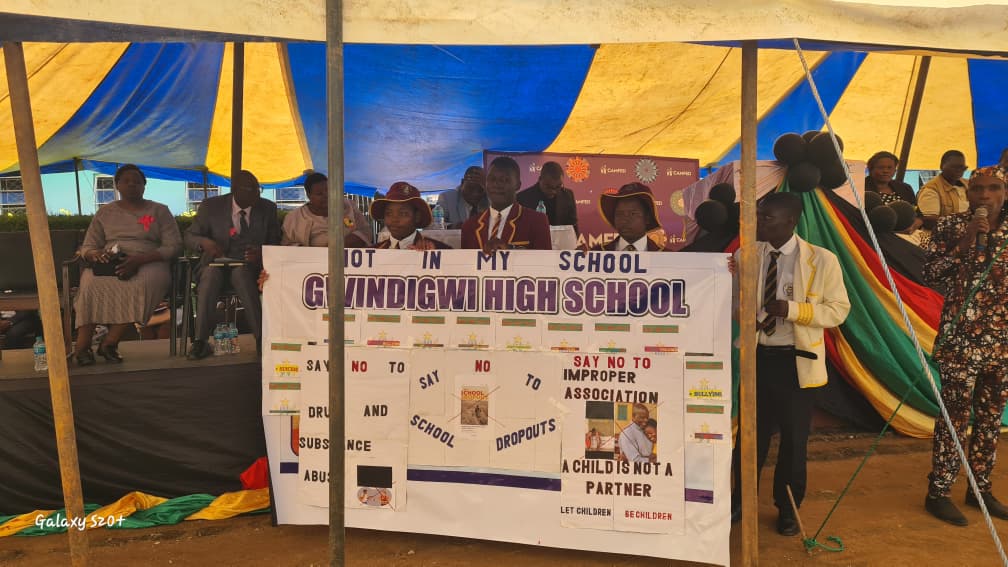
THE Government through the Ministry of Primary and Secondary education and the Campaign for Female Education (CAMFED Zimbabwe) have backed their fight against violence, drug abuse, and early marriages in schools through the launch of “The Not in My School campaign” at Gwindingwi High School in Bikita District, Masvingo Province this Wednesday.
The event doubled as a community engagement meeting and drew a significant turnout of traditional leaders, education officials, teachers, learners, parents, and members of the CAMFED Association from surrounding schools.
The event was in full support of local traditional Chiefs in Bikita District who include Chief Budzi, Chief Marozva, Chief Mazungunye, Chief Mukanganwi, Chief Ziki, Chief Mabika among others.
Chief Budzi, who served as the guest of honour, delivered a powerful address in which he declared schools and communities under his jurisdiction as zones of peace while he condemned the rising scourge of drug and substance abuse, bullying, gangsterism, and early child marriages.
“A school used to be a place where we sent our children to sharpen the spear of the mind. It was a place of safety. But today, reports reach my ears that make me weep. I hear of blood on the playground. I hear of children afraid to walk through the gates because they have been turned into places of violence than growth and development as they used to be back in years,” Chief Budzi said.
He described drugs such as mutoriro, guka, mbanje, and broncleer as thieves that rob the minds, ambition, future, and ultimately life. “If you are in my jurisdiction, your school is my backyard. And I will not have my backyard defiled by violence,” he added.
The chief also addressed the issue of teen pregnancy and early marriages, which have contributed significantly to school dropouts in the district. Last year alone, Gwindingwi High School recorded 79 dropouts, all attributed to early pregnancies and early marriages.
“To my daughters, you are the pillars of the future. But the pillar cannot hold the roof if it is broken too early. Teen pregnancy is robbing us of female doctors and leaders,” Chief Budzi said. He issued a stern warning to men preying on schoolgirls. “A child is not a bride. A school uniform is not a wedding dress. If I catch any family marrying off a schoolgirl, you will answer to the law and to the traditional court.”
All the traditional chiefs present pledged their support for the initiative, agreeing to work together to create safer learning environments across the province.
CAMFED Zimbabwe, which has been at the forefront of supporting girls’ education, reaffirmed its commitment to the campaign. The organisation’s Policy and Advocacy Manager spoke at the event, highlighting the need for collective action to remove barriers to education.
“We are here to say yes to education, yes to empowerment, and yes to a brighter future for all,” the manager said. “CAMFED Zimbabwe commits to advocate for policy changes that protect girls’ education, provide scholarships and educational support, train teachers and mentors for inclusive education, engage communities to promote girls’ empowerment, and support student-led initiatives and activism.”
The manager also underscored the importance of safe and inclusive environments, mentorship, and healthy lifestyles, while saying no to early pregnancies, early marriages, drug abuse, violence, harassment, bullying, discrimination, and child exploitation.
The launch of the Not In My School campaign in Masvingo Province marks the beginning of a sustained effort to mobilise communities around the protection of children. Chief Budzi called for the reinvigoration of child protection committees in every school to monitor pathways to school and support teachers.
“I, Chief Budzi, hereby declare our schools and communities’ zones of peace,” he proclaimed, drawing cheers from the gathering. “No to drugs, no to bullying, no to early marriage, no to stigma and discrimination, and yes to education.”
The campaign is expected to roll out across the province with the backing of traditional leaders, education authorities, and civil society partners such as CAMFED.