
By Bigboy Madzivanzira, Medical Rehabilitation Practitioner, HPCT Zimbabwe
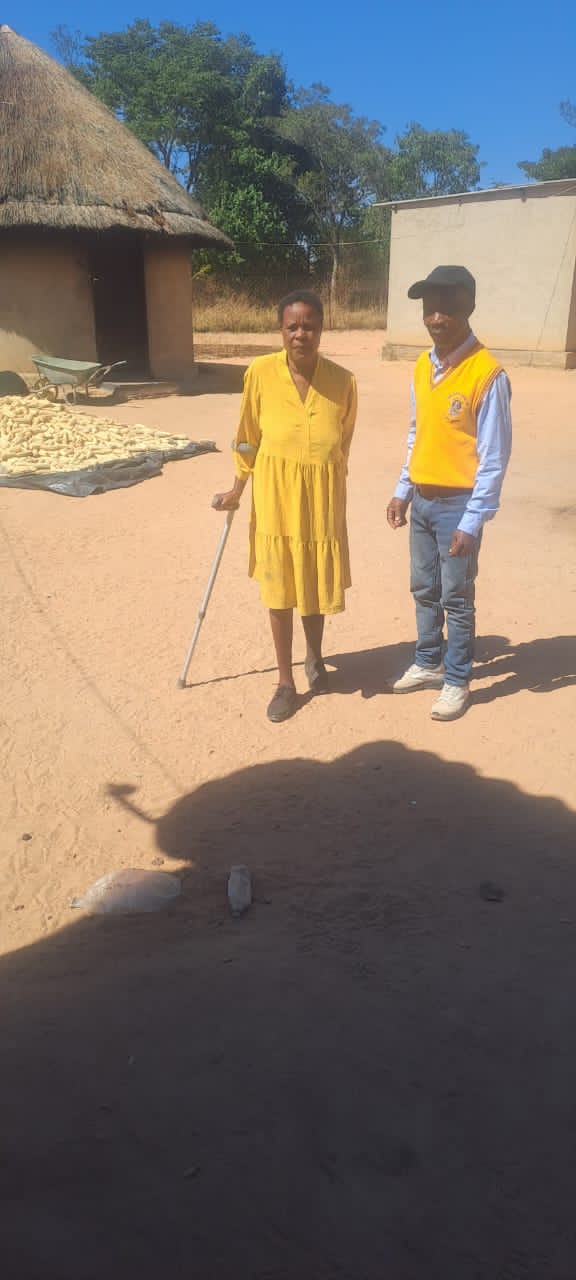
In Nyarumwe Village under Chief Zvimba, 65-year-old Roseline Taruwinga knows what it feels like to be stuck.
Born 29 November 1960, Roseline had her left leg amputated below the knee in 2023 after complications from diabetes mellitus. Since then, her world shrank to the space around her homestead.
Her first prosthetic leg broke within months. The wheelchair she relied on collapsed while her husband was pushing her to hospital. And every month, the family spends USD 45 on medication — a heavy burden for a rural household living on small-scale farming.
When Health Promotion Clinic Trust, HPCT Zimbabwe, heard about Roseline through Lion Jera, they didn’t ask her to come to Harare. They went to her.
The outreach process
March 2026 – Assessment
Bigboy travelled to Kutama, Zvimba to meet Roseline and her husband. He carried out a full assessment:
1. Stump assessment: Checked healing, skin condition, and shape to ensure it was ready for prosthetic fitting.
2. Medication review: Roseline had gone a week without medication after her supply ran out. Her granddaughter Memory noticed and called her aunt, who brought more. “She monitors my medication and knows them well like a doctor,” Roseline said with a smile.
3. Mobility assessment: The wheelchair they had was broken beyond repair from use on rough rural roads.
4. Caregiver training: Roseline and her husband were trained on stump care, skin checks, and safe transfer techniques.
May 2026 – Fitting
Once the prosthetic was fabricated, Bigboy returned to Kutama for the fitting, initial gait training, and adjustments. Follow-up visits are planned for the next 6 months to check fit, skin condition, and usage.
Why this matters
For Roseline, a prosthetic leg is not about walking long distances. It’s about moving inside her homestead, standing to cook, stepping outside to sit in the sun, and reducing the physical strain on her husband.
“Her first leg broke and we had no means to replace it,” her husband told Bigboy. “Without it, she stays in bed or in the chair all day.”
By doing the assessment and fitting in Kutama, the team cut transport costs for the family, reduced time away from the farm, and made sure the intervention happened in the environment where Roseline actually lives.
The power of family in rehabilitation
Roseline’s story highlights something seen across rural Zimbabwe: families step in when the system can’t reach them. Her granddaughter Memory monitors medication, her aunt responds when there’s a gap, and her husband manages daily care and mobility.
Community-Based Rehabilitation works because it builds on this. The family is not replaced. They are equipped with skills and knowledge to manage between clinical visits.
This approach follows international standards from the International Society of Wheelchair Professionals, ISWP, and the World Health Organization.
About the work
Health Promotion Clinic Trust, HPCT Zimbabwe, is a registered organization providing clinical, educational, and technical rehabilitation services in underserved communities. Their team is ISWP-accredited in wheelchair technology.
Bigboy leads the outreach program. He is a registered Medical Rehabilitation Practitioner with the Medical Rehabilitation Practitioners Council of Zimbabwe and a registered Health Promotion Practitioner with the Allied Health Professions Council of Zimbabwe. He holds a degree in Special Needs Education, a diploma in Family Therapy, and a certificate in Wheelchair Technology from Mobility India. He has worked on CBR programs with Jairos Jiri Association, HelpAge International Refugee Programme, and ZIMNAMH. He is also Chairperson of the Disabled Women Support Organization.
Partnership and support needed
HPCT Zimbabwe runs its outreach program using public transport to reach clients in rural areas like Zvimba. While this allows services to reach people who cannot travel, it limits the amount of equipment and number of clients that can be served per trip.
HPCT is seeking partners and supporters to strengthen its outreach capacity. Support for transport, prosthetic components, mobility devices, and medication would allow the team to reach more clients, reduce costs for families, and carry out more frequent follow-ups.
Anyone willing to sponsor medication or wheelchairs is welcome.
The bigger picture
Roseline’s case is not unique. Across Zimbabwe, thousands of people with amputations and mobility impairments are stuck at home because services are too far, too expensive, or too infrequent.
Outreach prosthetic and rehabilitation services bridge that gap. They restore mobility, reduce dependence, and keep families together.
HPCT Zimbabwe is not just fitting legs. They are restoring dignity, independence, and the ability to participate in family and community life.
About the Author
Bigboy Madzivanzira is a registered Medical Rehabilitation Practitioner with the Medical Rehabilitation Practitioners Council of Zimbabwe and a registered Health Promotion Practitioner with the Allied Health Professions Council of Zimbabwe. He leads the outreach program at Health Promotion Clinic Trust, HPCT Zimbabwe.
He holds a degree in Special Needs Education, a diploma in Family Therapy, and a certificate in Wheelchair Technology from Mobility India. He has extensive experience in Community-Based Rehabilitation programs with Jairos Jiri Association, HelpAge International Refugee Programme, and the Zimbabwe National Association for Mental Health, ZIMNAMH.
Bigboy is also Chairperson of the Disabled Women Support Organization, an ISWP-accredited practitioner in wheelchair technology, and a member of the Community Based Rehabilitation Africa Network, CAN.
Contact
For more information on HPCT Zimbabwe’s outreach programs, or to discuss partnership opportunities, contact Bigboy Madzivanzira on 0773 367 913 or email healthpromotionclinic@gmail.com.