
By Gideon Madzikatidze/Simbarashe Sithole
SANDAWANA, MBERENGWA – Mutapa Energy Resources has moved from exploration rhetoric to full-scale development at Sandawana Lithium mine, unveiling a US$43.9 million community and infrastructure package that redefines responsible mining in Zimbabwe’s lithium corridor.
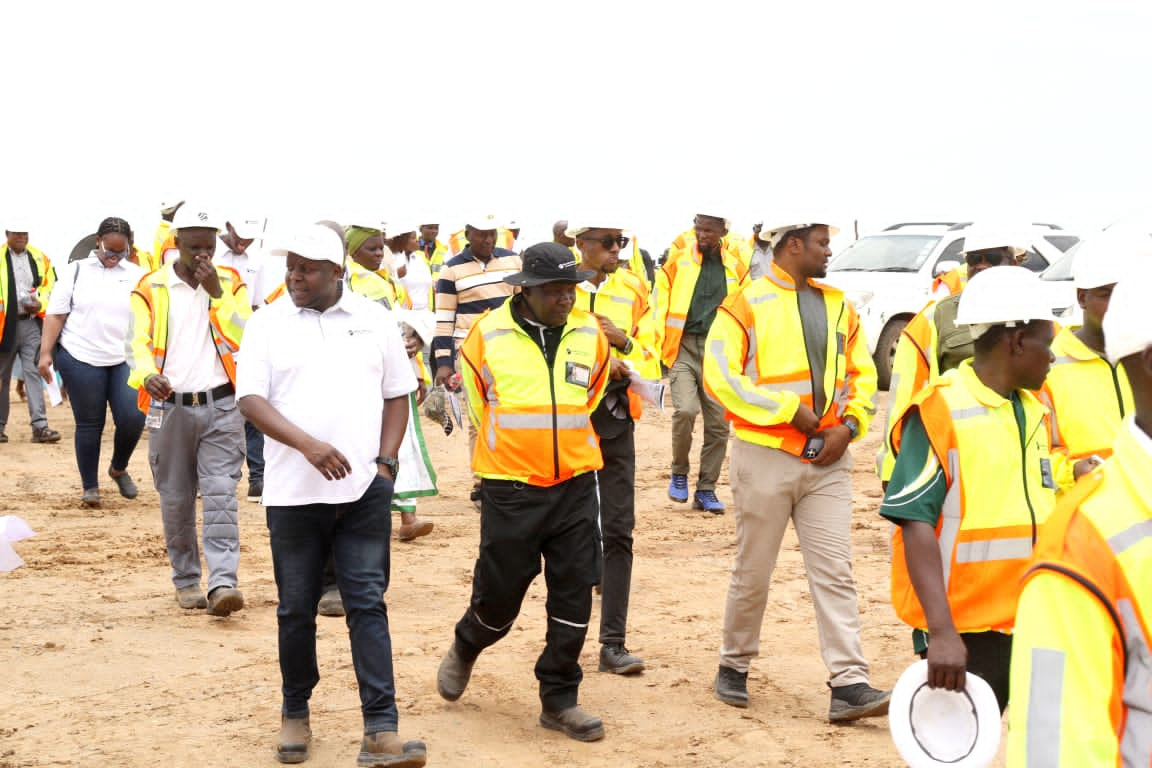
The figures were laid bare during a joint media and parliamentary tour of the project, led by the Parliamentary Portfolio Committee on Mines and Mining Development.
Speaking at the mine face, Mutapa Energy Resources Chief Executive Officer, Mr Innocent Rukweza, said the company is deliberately front-loading social infrastructure before full ramp-up of the concentrator.
“As Sandawana, Mutapa Energy Resources, we are strongly committed to the community in which we operate and to improving their livelihoods,” said Rukweza.
“Our target is US$3.3 million that we are hoping to put in just the relocation alone. The school, a modern police station, the clinic and the 104 households, together with the water reticulation and everything that has to do with improved livelihood,” he added.
That US$3.3 million is ring-fenced for the Resettlement Action Plan (RAP) alone. It excludes the company’s wider Corporate Social Responsibility (CSR) and Environmental, Social and Governance (ESG) spend. Rukweza revealed the company is separately financing the upgrade of a local secondary school to high school status, plus economic empowerment programmes for host communities, all outside the relocation envelope.
Rukweza said the biggest ticket item, however, is connectivity.
“The road alone, the service road, is going to be another US$40.6 million. That is the budget that we are going to invest to ensure the community is uplifted,” he said.
In mining terms, that is not an access track. That is a haul road, service corridor and community lifeline, built to open the orebody, de-risk logistics and permanently link Sandawana to the national grid of commerce.
Where many projects stall on cultural flashpoints, Mutapa moved with traditional leadership. Rukweza disclosed that 69 graves sat directly in the footprint of the planned plant.
“We facilitated the exhumation and reburial of those bodies. What we did is that we consulted the local chiefs. We just didn’t do it the way we thought it was [right],” he said.
For Parliament, that process matters. It is the difference between a contested Social Licence to Operate (SLO) and a project with genuine Free, Prior and Informed Consent (FPIC).
Chairperson of the Parliamentary Portfolio Committee on Mines and Mining Development, Honourable Remigio Matangira, said what legislators saw at Sandawana is exactly what the Mines and Minerals Act, NDS2 and Vision 2030 demand, beneficiation at source, local content and shared value.
“What we have witnessed at Sandawana complements Vision 2030. This is not extractive mining. This is development mining,” Matangira said.
“When a company invests in schools, clinics, police stations, water and roads, it is conforming to empowerment and development of local communities where mining activities are taking place. That is how we build an upper-middle-income economy, from the ground up, with the host community as a shareholder in progress, not a bystander,” he added.
Matangira challenged other lithium players to benchmark against Sandawana on local employment, procurement from community suppliers, and value addition, warning that Parliament will continue to exercise oversight to ensure Community Share Ownership Trusts and devolution funds translate into tangible infrastructure, not boardroom promises.
Sandawana is not just about spodumene and petalite. It is about Zimbabwe positioning itself in the global energy transition value chain, from ore, to concentrate, to battery-grade lithium chemicals.
With US$3.3 million for resettlement and US$40.6 million for the service road already committed, Mutapa Energy Resources is signalling one thing to investors, to Parliament and to the community: Sandawana is not a speculative claim. It is a mine under construction, with a community attached to its balance sheet.