
By Nevison Mpofu
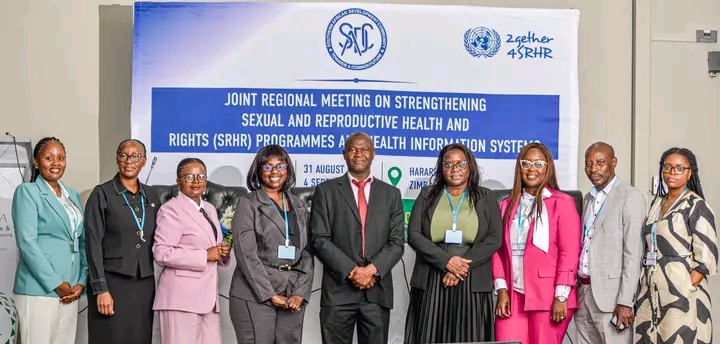
HARARE, Zimbabwe — Sexual and reproductive health and rights (SRHR), gender, monitoring and evaluation (M&E), and health information systems (HIS) experts from across the Southern African Development Community (SADC) are meeting in Harare from 31 August to 4 September 2026 to strengthen regional approaches to health programming and accountability.
The five-day joint regional meeting brings together SRHR programme managers, monitoring and evaluation specialists, and health information systems experts from 15 SADC Member States, with Comoros not represented.
The meeting is being held under the theme: “Accelerating Implementation, Monitoring and Reporting of the SADC SRHR Strategy 2019–2030.”
Participants are focusing on how the region can accelerate implementation of commitments made under the SADC SRHR Strategy and ensure that these commitments translate into tangible improvements in the lives of women, girls, adolescents, young people, men and communities, particularly vulnerable and underserved populations.
Ms Thembi Zulu, Deputy Director in the Women’s Health Department at South Africa’s Ministry of Health, said the meeting was important because regional commitments must be translated into action.
“We want to make sure that commitments we made as a region change the lives of women, girls, adolescents, young people, men and communities, especially those left behind. Strategies do not save lives. Implementation does. Reports do not create accountability unless someone is prepared to act on what the evidence is telling us. This is why this meeting matters.”
Zulu said SADC countries were operating in a fundamentally different global environment from the one in which many of their health programmes were originally designed, making it necessary to identify and address gaps across the health system.
She said the region was facing multiple, interconnected crises that were placing additional pressure on health systems.
“SADC is experiencing colliding crises. Climate change is intensifying health risks. Conflicts and humanitarian emergencies are disrupting health services and displacing populations. Economic pressure, debt and fiscal constraints are shrinking the space available for public investment. The geopolitical environment is becoming more fragmented and competitive.
The international financing architecture is becoming less predictable.”
She stressed that sustained investment in health remained critical to ensuring that essential health services continue to function, particularly in increasingly challenging environments.
“Core health funding remains critical for health systems to function effectively in hostile environments. Domestic public financing remains the cornerstone of resilient and equitable health systems,” she said.
Zulu noted that SRHR services—including reproductive autonomy, maternal healthcare, adolescent health, HIV prevention and treatment, contraception, safe and respectful maternity care, and protection from gender-based violence—were increasingly vulnerable amid growing financial pressures on countries.
She said SRHR should not be treated as a stand-alone component of health programming, but rather as an integral part of building resilient health systems at both national and regional levels.
“SRHR is facing increasing pressure within regional country budgets. SRHR must become an integral part of resilience and must be connected to health systems at national and regional levels,” she said.
The meeting is expected to place implementation at the centre of accountability, while encouraging countries to transform monitoring and reporting systems into tools for strategic decision-making and intelligence.
Participants are also expected to strengthen the use of an equity lens in health planning, protect SRHR programmes from fragmentation and redefine regional cooperation against the backdrop of declining and increasingly unpredictable financing.
Zulu said countries should also prepare for emerging SRHR challenges rather than focusing solely on measuring problems that are already known.
“Prepare for the SRHR challenges that are coming, not only measure those we already know.”
She said climate change was likely to have significant implications for maternal health, pregnancy, access to essential services and reproductive health outcomes.
Migration and population mobility could also affect continuity of care, while rapid urbanisation and demographic changes were expected to reshape demand for health services.
At the same time, digital technologies were likely to transform how people accessed health information and services, while geographical and economic shocks would increasingly test the resilience of health systems.
Zulu urged SADC countries to strengthen their health information and monitoring systems so that they could anticipate emerging challenges and support timely interventions.
“Let us build a system that simply tells us what is to come next.”
The Harare meeting therefore provides an opportunity for SADC countries to assess progress in implementing the regional SRHR strategy, strengthen monitoring and reporting mechanisms, and develop practical approaches to ensure that health commitments translate into improved services and outcomes across the region.