
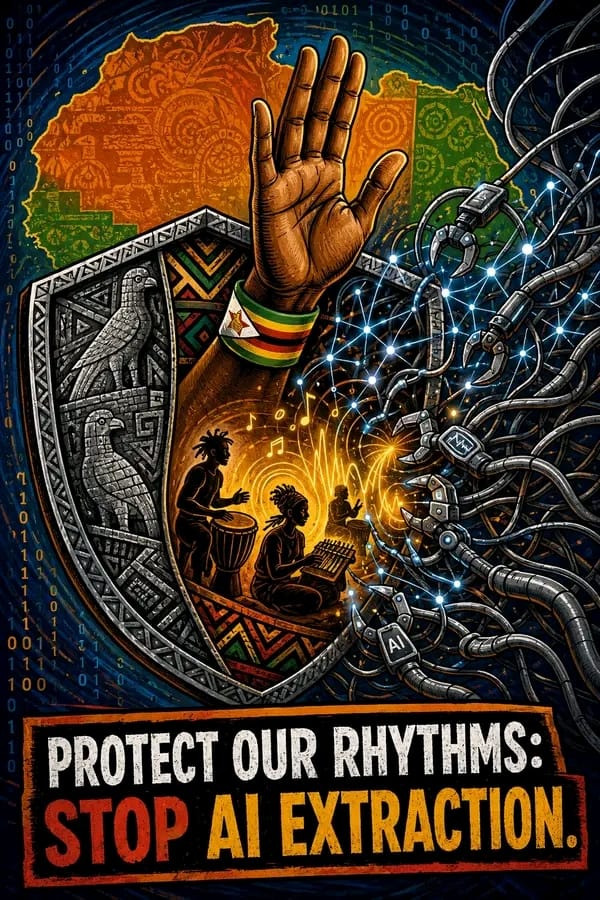
The new frontier of resource extraction in the Global South is not minerals—it is cultural data. Global tech companies are quietly deploying web crawlers to scrape YouTube, SoundCloud, and streaming platforms, harvesting thousands of hours of Zimdancehall, Sungura, and traditional Mbira tracks. This data is fed into machine learning algorithms to train generative AI audio models. The result is artificial intelligence that can synthesize African rhythms and melodies on demand, directly competing with the original Zimbabwean creators who receive zero credit, consent, or compensation.
This phenomenon is a modern iteration of data colonialism. While Western AI developers argue that ingesting publicly available music constitutes “fair use,” they are effectively strip-mining the cultural IP of the Third World to build multi-billion-dollar proprietary products. Recent audits of global AI datasets reveal that while Global South genres are massively underrepresented in academic research, they are heavily targeted for commercial extraction.
Why ZIMURA and ZICCO are Struggling to Defend Artists
Local Collective Management Organizations (CMOs) like the Zimbabwe Music Rights Association (ZIMURA) and the Zimbabwe Copyright Collecting Office (ZICCO) are structurally paralyzed by this new threat:
Outdated Legal Frameworks: ZIMURA operates under the Copyright and Neighbouring Rights Act [Chapter 26:05], which was designed for radio broadcasting, physical formats, and traditional piracy. It does not account for algorithmic data scraping or machine learning ingesting copyrighted outputs.
Lack of Technical Infrastructure: CMOs currently lack the forensic digital tools required to audit proprietary AI models and prove that a specific Zimbabwean artist’s work was used in training weights.
Jurisdictional Limits: ZIMURA cannot easily litigate against Silicon Valley tech giants operating outside Zimbabwean borders without massive financial and legal backing.
The Policy Fix: Government Action and the AI Strategy
To protect creators, the Zimbabwean government must urgently modernize its intellectual property laws. The National Artificial Intelligence Strategy (2026–2030) must be paired with immediate statutory amendments to the Copyright Act to explicitly define unauthorized AI data mining as an infringement. The state should mandate an “opt-in” licensing framework, requiring foreign developers to secure explicit consent and pay licensing fees before scraping local content. Furthermore, the government can implement digital levies on foreign AI services to fund a national cultural preservation and remuneration trust.
The Role of Civil Society Organizations (CSOs)
CSOs serve as a critical bridge for digital rights, algorithmic accountability, and fighting technological inequality. Digital rights coalitions must:
Commission independent forensic audits of AI datasets to expose unauthorized use of African cultural assets.
Provide digital rights and literacy training to artists, demonstrating how metadata tagging and data-poisoning techniques can protect their works online.
Advocate for transparent internet governance frameworks that treat cultural data sovereignty as a fundamental digital right.
Global Defense and International Regulations
The Third World cannot fight AI data extraction in isolated silos. Protection requires regional harmonization through the African Continental Free Trade Area (AfCFTA) Digital Trade Protocol, establishing unified continental data governance rules that force foreign tech companies to negotiate with Africa as a single bloc.
On a global scale, the EU AI Act offers a blueprint for accountability; its extraterritorial reach requires AI developers operating in Europe to publish detailed summaries of their training data, regardless of where the model was built. African nations can leverage the UNESCO Recommendation on the Ethics of AI and push the World Intellectual Property Organization (WIPO) to adopt binding international treaties that criminalize uncompensated cultural data extraction. Until then, the Global South must build regulatory and technical safeguards around its digital archives, ensuring that the next wave of technological wealth is not built on the unpaid labor of African artists.
Alliance for Responsible Technology & AI (ART-AI Zimbabwe)
- Leading civil society advocacy in this space is the Alliance for Responsible Technology & AI (ART-AI Zimbabwe), coordinated by Shingirai Nyahwa. ART-AI Zimbabwe works across the intersection of digital rights, technology policy, and algorithmic justice. The initiative monitors emerging AI developments, advocates for ethical and rights-respecting AI governance frameworks, pushes for data sovereignty, and champions equitable digital policies that protect local creators, marginalized communities, and civic spaces from digital exploitation and systemic algorithmic harms