
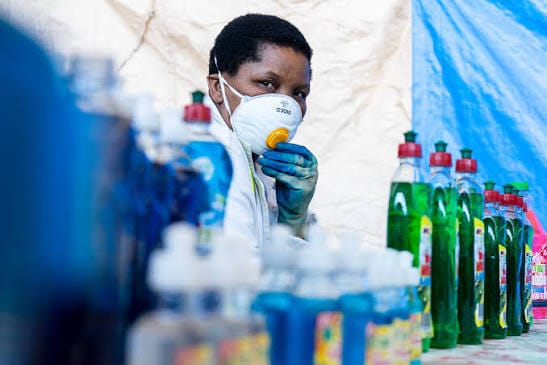
…Backyard detergent makers in Harare mixing products. Experts say proper gloves, masks and ventilation are needed to prevent long-term health problems.
By Bigboy Madzivanzira
Founder & Director, Health Promotion Clinic Trust
Zimbabwe Representative, CAN Africa Network
“I will never make ant killer or termite poison. You will be dying slowly from inhaling the fumes.”
That’s what a Harare detergent manufacturer told me last week. And it stopped me in my tracks.
A Business of Survival
Walk through Mbare, Highfield, or Eastlea and you will find them. Backyard factories.
Young men and women mixing washing powder, bleach, dishwashing liquid and disinfectant in 20L drums. For many, this is survival. No jobs. No capital. Just determination to feed families and pay school fees.
The problem? Most learned from YouTube or “a guy who taught me.” No training. No gloves. No masks. Mixing caustic soda and acid in kitchens with windows closed.
Dying Slowly
We celebrate entrepreneurship, but we ignore the cost.
The fumes from these chemicals attack the lungs. Day after day. The caustic soda burns the skin. The acids damage the eyes. Over months and years it becomes asthma, chronic coughs, liver and kidney problems, nerve damage.
I see it at Health Promotion Clinic Trust. People coming in with breathing problems and skin conditions directly linked to chemical exposure. Some end up with permanent disabilities.
And it’s not just the maker. Children help. Families inhale the fumes. Customers use strong disinfectants in closed rooms.
It’s a Health, Disability AND CBR Issue
As Zimbabwe Representative for CAN Africa Network and a CBR practitioner, this is exactly the work we do.
CAN Africa Network is the continental body that promotes Community Based Rehabilitation across Africa. Our mission is to ensure Persons with Disabilities and their families are included in health, education, and safe livelihoods.
Chemical exposure is creating new disabilities in our communities. When a breadwinner becomes sick or disabled from their own business, the whole family falls into poverty. People with disabilities, the elderly, and children suffer most because they cannot easily escape fumes or handle dangerous chemicals safely.
We Need Solutions, Not Shutdowns
We cannot kill livelihoods. But we cannot allow people to die for a living either.
Through CAN Africa Network and HPC Trust, we are calling for:
1. Training: Basic chemical safety from MoHCC. Gloves, masks, ventilation. First aid for burns. CBR workers can deliver this at community level.
2. Safer Products: Promote non-toxic pest control and plant-based cleaners. That manufacturer refused poisons. Others can too.
3. Support: Local authorities and health workers should educate, not just inspect and close.
4. Community Awareness: Through clinics, churches and CBR programs. Prevention is cheaper than treatment.
Final Word
That detergent maker chose health over profit. It was a hard choice, but a wise one.
As Zimbabweans, let’s build businesses that feed families without breaking bodies.
No one should build a livelihood only to lose their health.
ABOUT CAN AFRICA NETWORK
CAN Africa Network – Community Based Rehabilitation Africa Network – is a continental network that promotes the inclusion of Persons with Disabilities through community-based services. CAN Africa works with governments, NGOs, health professionals and DPOs to advance the CBR Matrix: Health, Education, Livelihood, Social and Empowerment.
About the Author: Bigboy Madzivanzira
Bigboy Madzivanzira, MRT, RHP, RFT, ISWP is the Founder & Director of Health Promotion Clinic Trust based in Eastlea, Harare. He is also the Zimbabwe Representative for CAN Africa Network – Community Based Rehabilitation Africa Network. A Medical Rehabilitation Practitioner , Health Promotion and CBR specialist, Bigboy advocates for health, disability inclusion and safe livelihoods across Zimbabwe. Through HPC Trust, he works with communities, clinics and DPOs to promote prevention, rehabilitation and community-based support for persons with disabilities and vulnerable groups.
He can be contacted on 0773 367 913 or email him on healthpromotionclinic@gmail.com