
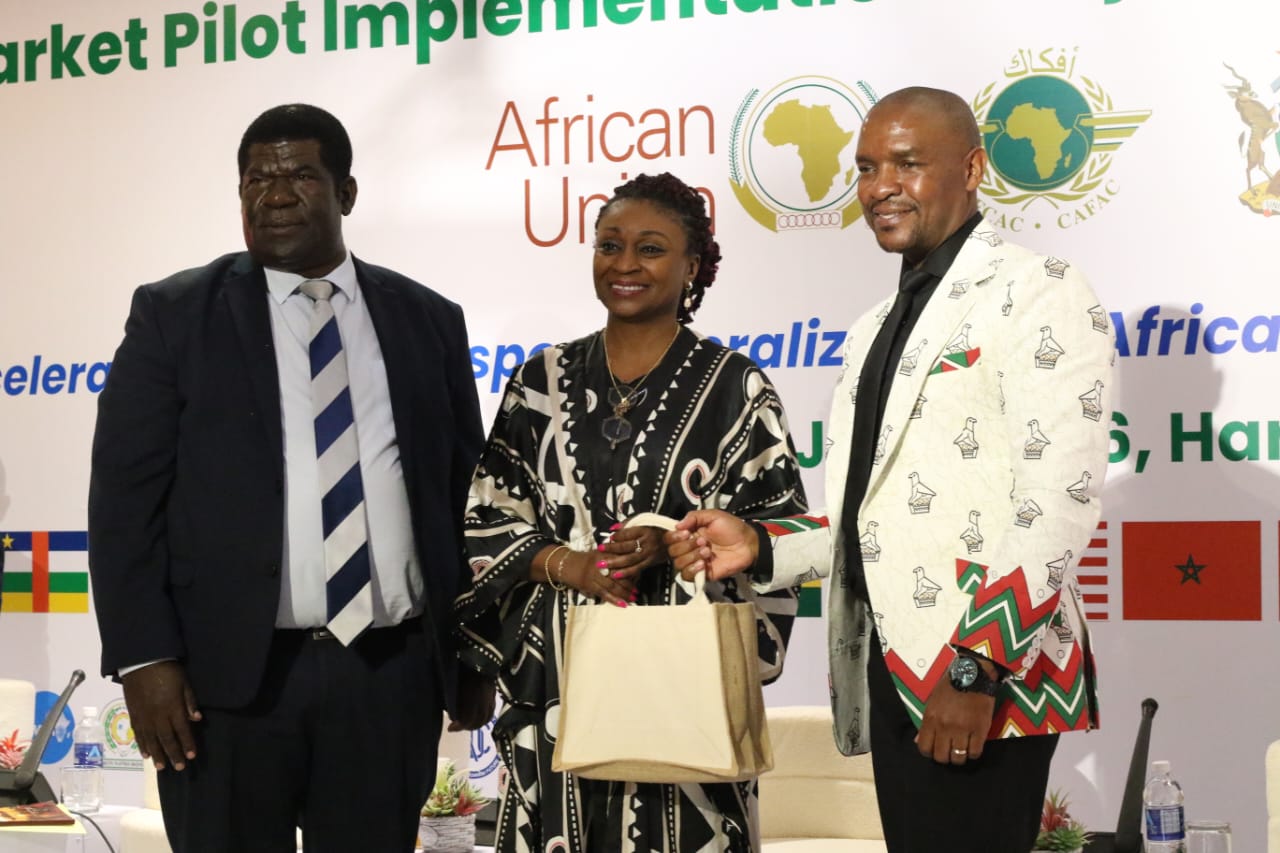
By Gideon Madzikatidze /Simbarashe Sithole
HARARE — Zimbabwe has been challenged to move ‘from commitment to measurable implementation’ of the Single African Air Transport Market, as government and aviation leaders gathered in Harare for the SAATM Pilot Implementation Project (PIP) Airshow.
Transport and Infrastructural Development Minister, Honourable Advocate Felix Mhona, said the theme (Acceleration of Air Transport Liberalisation in Africa to Improve Continental Connectivity and Integration) was timely and contextually essential.
“The SAATM facilitates the seamless movement of people, goods, services and investment across the African continent, as we move towards the Africa we want by the year 2063,” Mhona said.
He added that Zimbabwe is “currently reassessing all BASAs with the SAATM member states, to ensure they are in compliance with the Yamoussoukro Decision (YD).”
The Minister noted that intra-African connectivity was shown to have jolted from 14.5% in 2021 to 23% in 2025.
Mhona said Zimbabwe has ‘implemented all eight SAATM Concrete Measures’ since signing the Solemn Commitment in 2022, and ‘reaffirms its unwavering support for the Lomé Ministerial Declaration of June 2026 on accelerating SAATM implementation’.
On infrastructure, he said government, through Public-Private Partnerships, had invested in the Joshua Nkomo International Airport, in Bulawayo; the Victoria Falls International Airport and the Robert Gabriel Mugabe International Airport, with capacity at Robert Gabriel Mugabe rising from approximately two million to 6.5 million passengers annually.
African Civil Aviation Commission Secretary General, Ms Adefunke Adeyemi, said the Airshow was not just another aviation event.
“It is a delivery platform. It is where policy must become routes, routes must become trade, and trade must become jobs,” Adeyemi said.
“The Lomé Declaration reaffirmed the Yamoussoukro Decision as the legal foundation for market liberalisation and SAATM as the practical framework for delivery,” Adeyemi added.
She said with “disciplined implementation, SAATM could generate an additional USD 450 to 700 million in GDP over five years, create 45,000 to 70,000 new jobs, and reduce intra-African fares by 15 to 27 per cent. That is the opportunity before us. And, frankly, that is also the cost of delay.”
Adeyemi proposed six immediate actions for Zimbabwe, including establishing “a national SAATM Implementation Task Force” and to “expedite facilitation reforms, including e-visa procedures, API/PNR readiness, risk-based border clearance.”
“The African sky must no longer divide our economies. It must unite them, empower them, and support our shared prosperity,” she said.