
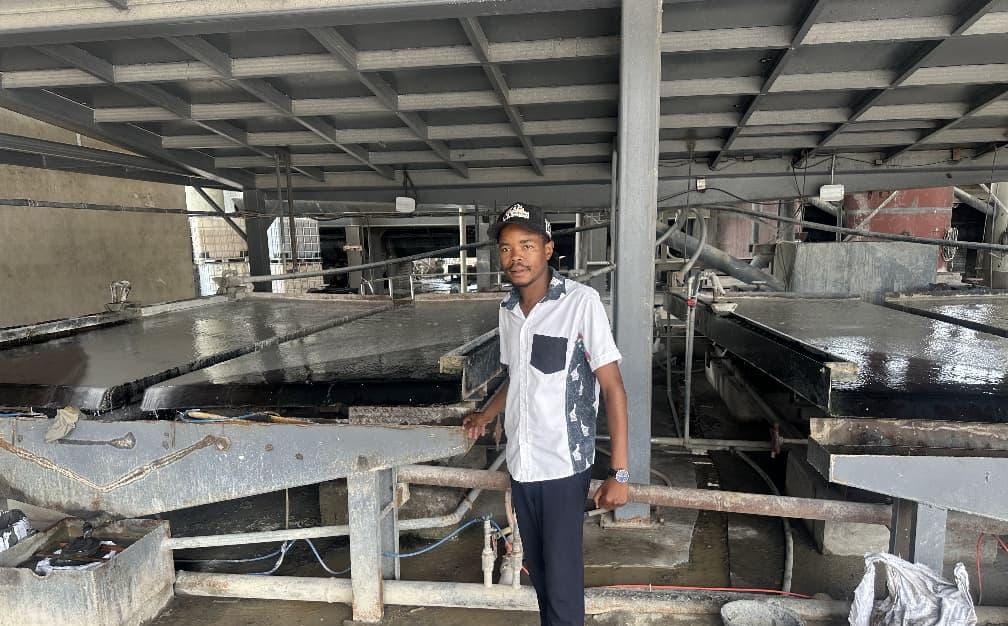
.…Nyasha Magadhi
By Desire Tshuma
As global competition over critical minerals intensifies, China continues to tighten its grip on rare‑earth exports while building billion‑dollar battery‑material plants across Asia and the Middle East. Zimbabwe—home to Africa’s largest lithium reserves and a growing strategic player in the energy transition—is seeing a generational shift.
Emerging local producers are not only welcoming Chinese investment but are actively pushing for deeper integration into the global supply chain, starting with domestic beneficiation and extending to green‑energy infrastructure.
“We see ourselves as part of this global realignment,” says Nyasha Magadhi, chairman of the Harare‑based Young Critical Minerals Producers of Zimbabwe (YCMPZ). “China’s presence in Zimbabwe is not about extraction alone—it is about industrialisation, value addition, and futures thinking.
We, as young producers, want to complement that effort by building competence, pushing for processing capacity, and ensuring Zimbabwe is not a pitstop, but a full node in the global battery supply chain.”
Magadhi’s remarks come as Beijing rolls out a tracking system for rare‑earth magnets and tightens export controls. Meanwhile, projects such as Zhongke’s US$1.1 billion lithium‑battery‑materials plant in Oman further cement China’s hold over the minerals‑to‑energy value chain.
For Zimbabwe’s junior miners, this is both an inspiration and a call to action.
Thanking China: Tariff Removal and Investment Inflows
Magadhi expressed gratitude for China’s supportive trade policies, especially the removal of tariffs on Zimbabwean critical minerals, which has boosted local producers’ competitiveness in the world’s largest battery‑materials market.
“China opened its doors to us when global markets were uncertain. The tariff elimination was not just a trade concession, it was an act of strategic partnership that has allowed young Zimbabwean miners to scale up, access premium prices, and reinvest into our operations,” he said.
Since 2021, Chinese investors have committed roughly US$4 billion to Zimbabwe’s lithium sector. Major players—Zhejiang Huayou Cobalt, Sinomine Resource Group, Chengxin Lithium, Yahua Group, and Tsingshan Holding Group—are driving the country’s beneficiation agenda.
The flagship Arcadia Technology Zimbabwe plant, a US$400 million facility owned by Prospect Lithium Zimbabwe (a Huayou subsidiary), will soon commission Africa’s first lithium‑sulphate plant, with annual output exceeding 60,000 t. Huayou’s total investment in Zimbabwe’s lithium value chain now stands at US$1.1 billion, covering mining, concentrators, and sulphate processing.
Prospecting the Future: New Lithium Plants on the Horizon
Beyond existing operations, young miners are actively developing new processing capacity. Magadhi confirmed that YCMPZ members are conducting exploration and feasibility studies across multiple projects.
“We are not waiting for opportunities to be handed to us. We are prospecting new ground, conducting feasibility studies, and positioning ourselves to build the next wave of processing plants,” he said.
Magadhi himself holds a 15 % stake in the Hao Lithium Processing Plant in Midlands province—a US$30 million investment that exemplifies indigenous youth participation in downstream beneficiation.
A New Generation of Mining Entrepreneurs
-Nyasha Chido (Ionosphere Investments) runs a lithium processing plant in Harare’s Bluffhill industrial area, targeting 36,000 t of concentrate annually, with plans to reach 70,000 t. The company also handles tin, tantalum, and beryl, and has secured export authorization from the Ministry of Mines.
Darel Mubu (BlackBull Mining Services) provides plant design and optimisation consultancy and operates a chrome washing and beneficiation facility in Mashonaland West, employing hundreds and promoting structured chrome processing.
The Young Miners Foundation has acquired a 300‑hectare chrome concession in Mashonaland West and launched the “Chrome Processing Initiative,” aiming to create at least 500 jobs.
The Second Republic: Raising Young Millionaires
Magadhi praised the Second Republic under President Emmerson Mnangagwa, whose Vision 2030 has opened economic space for youth to own processing plants and equity stakes.
“The Second Republic has created an environment where young people can genuinely become millionaires—not through speculation, but through real productive capacity in critical minerals,” he said.
Policy actions support this: over 5,000 small‑scale miners in Shurugwi District benefited from a US$1 million equipment facility from Chengxi Investments, illustrating public‑private partnerships that boost youth and women participation.
Skills Transfer and Technical Capacity Building
Wayne Mudamburi, president of the Association of Junior Mining Professionals of Zimbabwe (AJMPZ), stressed that junior miners must become innovators and ESG custodians, not just raw‑material suppliers.
“China’s roadmap shows us what’s possible. Our members want to move from pit to plant—to be processors, not just suppliers,” Mudamburi said.
AJMPZ is rolling out technical‑skills programmes and seeking partnerships to localise parts of the lithium and rare‑earth processing chain. Training initiatives, such as the “Fundamentals of Chrome Washing Management” course run by the Young Miners Foundation with Ngayin Consultants, are already equipping youth with plant‑optimization and environmental‑compliance skills.
A Geopolitical Tipping Point
The global race for rare earths and battery metals has reached a tipping point. U.S. and EU auto groups warn that Beijing’s export curbs on rare earths are already affecting EV motor and magnet supplies. Zimbabwe, which has banned lithium ore exports and is pushing for full beneficiation, sees both risk and opportunity.
“We welcome China’s seriousness in long‑term planning,” Magadhi noted. “But we also want to ensure that young Zimbabweans are building wealth, skills, and sustainable businesses within these new value chains. It should be a partnership—not just a transaction.”
Both YCMPZ and AJMPZ advocate for policies that encourage local ownership in downstream operations, including cathode and anode manufacturing, battery recycling, and small‑scale energy‑storage innovation.
“It’s not enough to export concentrate,” says Mudamburi. “If Zimbabwe wants to remain relevant, we must also start thinking about how our minerals can power African EVs, local energy grids, and circular economies. We don’t want to remain consumers of finished technologies—we want to be contributors to the technologies themselves.”
President Mnangagwa has repeatedly challenged youth to “occupy the space” and drive transformation across agriculture, mining, tourism, manufacturing, SMEs, and science and technology. In that spirit, Zimbabwe’s young mining leadership hopes to emulate China’s integrated, long‑term approach—turning mineral wealth into sustainable, youth‑driven industrial growth.